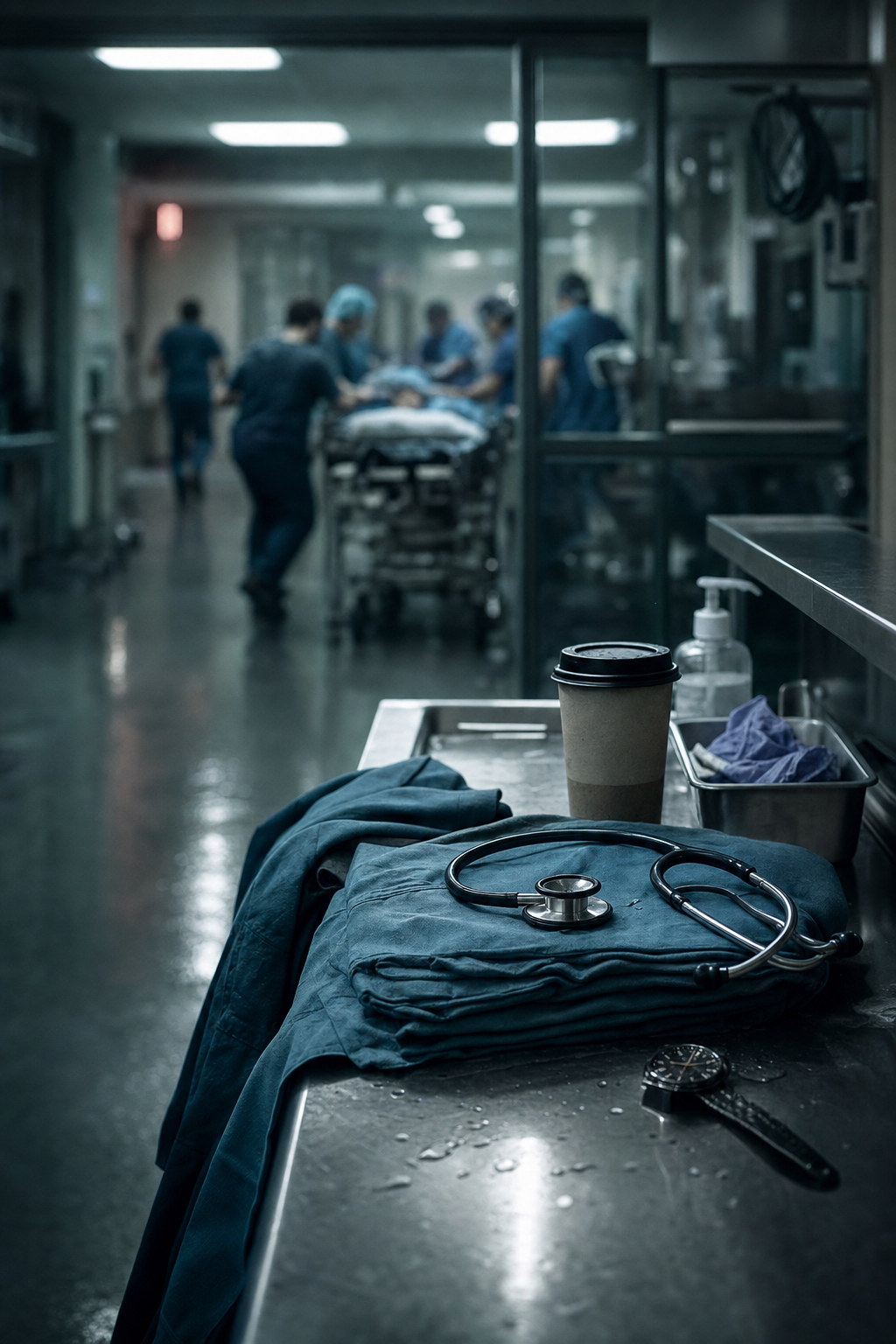
CHAIN OF CUSTODY
In an overworked urban trauma center, a surgeon survives chaos until a routine review starts dismantling the life she built inside it.
Chapter 1
The spleen was out by 07:41 and the bleeding had slowed to what counted, in OR 4 at Briarfield Medical Center, as controlled.
“Clamp,” Mara said.
Anil Mehta put the instrument in her hand before she looked up. Good. He was learning to stay half a beat ahead of the request. Mara adjusted the angle, found the vessel again in the blood-dark field, and tied it off with two clean motions.
“Talk me through the variant,” Anil said from across the table, his voice muffled behind mask and shield.
“The artery’s high,” Mara said. “Not where the scan suggested. If you go hunting where the textbook says it should be, you lose time. In blunt trauma, losing time is the only unforgivable thing.”
“Got it.”
She did not ask if he did. There was no room in the case for reassurance. The patient, a forty-six-year-old driver pulled from a collapsed sedan on I-87, had come in hypotensive and gray. The spleen had been worse than the imaging. It was often worse than the imaging. Most things were.
“Retract.”
Anil adjusted. Mara deepened the exposure and worked from the part of herself that required no translation. Suction. Tie. Pack. Check the tail of the pancreas. Reassess the field. Her hands moved in the practiced economy of eighteen years in the same fluorescent light, with the same low HVAC hum and the same monitor tones flattening crisis into data.
Her phone buzzed once in the left pocket of her scrub pants.
The vibration touched her thigh and was filed with everything else that did not belong in the room. Later. The word had done a great deal of work in her life.
“Pressure?” she asked.
“Up to ninety-two systolic,” Peters said from anesthesia. New attending. Careful. Good hands with lines.
“Fine,” Mara said. “We close.”
Anil glanced at the basin where the spleen sat, dark and slick and already becoming specimen rather than organ. “You want me to start fascia?”
“You can start when you can tell me what you’re closing over.”
He answered. Not perfectly. Well enough. Mara corrected one point about the short gastrics and another about the plane, then let him place the first stitch while she watched his wrists. Too much movement in the right. He would lose that with time or the work would take it from him.
The rest of the close went quickly. The patient was stable enough for ICU, the note was already assembling itself in the back of her mind, and she was calculating the day’s schedule while Anil cut suture under her instruction. This case had run thirty-seven minutes past slot. Thirty-seven minutes would push the gallbladder in OR 2, which would delay turnover for Park, which would mean one of the add-ons slid into late afternoon. She knew the board without looking at it. She had been doing this since before Anil finished college.
“Good,” she said when the final dressing was on. “Get the operative findings straight before you dictate. If the note reads like you didn’t know what you were seeing, the chart will believe you.”
Anil nodded. “Yes, Dr. Cavanaugh.”
She stripped her gloves. The snap of nitrile off damp skin was small and sharp in the room’s cooling quiet. The worst of the work was over. The body on the table was warm and alive and headed somewhere other than the morgue. Acceptable outcome. She moved to the recorder mounted by the wall.
“Operative report. Patient is a forty-six-year-old male status post motor vehicle collision with grade four splenic laceration and hemoperitoneum…” Her voice came out the way it always came out: flat, clear, usable.
By the time she finished dictating, transport was at the door. She signed the op note, gave Peters a brief nod, and pushed through into the corridor.
The surgical wing was its usual morning self: gurneys moving fast enough to matter but not fast enough to count as running, overhead pages half-heard over the hum, the smell of disinfectant overlaid with stale coffee and something fried from the cafeteria two floors down. Ceiling tiles with old water marks. Fluorescent lights that did not acknowledge weather, season, or time of day. A machine in continuous operation.
Her phone buzzed again as she walked.
This time she checked it because she was between rooms and because if it was the floor about the bowel obstruction in 6B she needed the call now, not later.
Not the floor.
Ryan: Heard you had another long one. You alive?
She looked at the message while standing beside a linen cart. For one second she could see the kitchen in the old apartment on Hawthorne, Ryan leaning against the counter in socks, asking ordinary questions in an ordinary voice. Then a resident pushing a portable monitor squeezed past with a muttered apology and the corridor returned.
Mara typed, Fine. Long morning. and sent it before she could think of an alternative that would not require more from either of them.
She slipped the phone back into her pocket and kept moving.
The break room coffee machine still had the yellowing strip of surgical tape on the front: JIGGLE HANDLE — NOT BROKEN. Mara did. The machine shuddered, coughed, and released something hot enough to qualify as coffee if nobody examined it too closely.
She drank it standing at the counter.
James Osei came in while she was halfway through the cup. He went to the machine, read the handwritten sign as if he had never seen it before, and said, “One day they’ll fix this and half the department will lose the will to live.”
It was almost a joke. At Briarfield that counted.
Mara said, “Wouldn’t survive the transition.”
James glanced at her then, quick and direct. Tall, steady, still in OR blues, gray showing at his temples under the cap. He took his coffee black and stood beside the sink.
“Still here,” he said.
It was not a question.
“Still here,” Mara said.
He nodded once. The nod held call nights, failed airways, dead patients, clean saves, and sixteen years of arriving in the same places at the same impossible hours. Then his pager went off and he looked at it and said, “ICU,” with the resignation of a man identifying weather.
She lifted the cup slightly in acknowledgment. He left. The room was quiet again except for the machine settling itself.
Mara finished the coffee, rinsed the cup because the break room had exactly four ceramic mugs and nobody needed another small failure before noon, and turned toward the microwave where staff kept forgetting lunches for three and four days at a time.
The dark glass gave her back a reflection before the inside light came on.
For a moment she saw herself as the room saw her when it was not asking anything: hair pulled back too tightly at the temples, shoulders a fraction high, skin around the eyes thinner than she remembered. Her face looked older than the face she presented in consults, in family meetings, in operating rooms where the body under the lights required steadiness and not age.
She looked away before the image could settle into anything useful. She put the mug down. She went back out.
Pre-op was running six minutes behind. Anil caught up to her outside bay three with a chart in one hand and a question already halfway formed.
“If the CTA shows possible mesenteric blush but the exam stays soft, are you still—”
“Yes,” Mara said. “Depending on the mechanism, the trend, and whether radiology has decided to describe concern or commit to it.”
Anil fell into step beside her. “So you trust the scan but not entirely.”
“I trust nothing entirely.”
He smiled at that. He was still young enough to smile quickly in hallways.
Mara took the next chart from him, flipped to the labs, and found herself looking at sodium, creatinine, hematocrit without absorbing any of it. The numbers were in front of her. They remained numbers. For one clean second her mind was elsewhere—not somewhere specific, not memory or worry or fatigue exactly. Just absent, as if a monitor had gone briefly dark and not yet alarmed.
Then the information clicked into place. HCT down two points. White count mildly elevated. Consent signed. She kept walking.
Anil had not noticed. Or if he had, he knew enough not to name it.
“On Thursday,” she said, handing the chart back, “you’re closing skin on the gastropexy. I want your knot tying cleaner than it was today.”
He straightened a little. “Yes, Dr. Cavanaugh.”
“That wasn’t praise,” she said.
His smile flickered, smaller now. “Understood.”
By 18:03 she had handed off the last post-op issue to the night team, signed two discharge summaries, answered a page about a fever that was not yet a fever, and stood for ten seconds at the edge of the OR board while the charge nurse rewrote tomorrow’s first cases in blue marker. Her name was where it always was. OR 4. 07:00. Cavanaugh.
She looked at the board long enough to confirm the sequence and long enough, though only barely, to feel the weight of how automatic the seeing was. Then she turned and walked to the elevators.
The parking garage smelled of concrete dust, oil, and heat stored all day in the upper levels. Her car was where she had left it at dawn. She got in, closed the door, and did not start the engine.
Three minutes passed.
The garage was dimmer than the hospital but not dark. A sedan pulled out two rows over. Somewhere below, a horn gave one short irritated blast. Mara sat with her hands on the wheel at ten and two, not because she was preparing to drive but because that was where her hands had landed.
Nothing in particular moved through her mind. No revelation. No inventory of the day. Just the body's minimum requirement to become someone who could enter the city after being, for fourteen hours, part of the hospital.
At 18:06 she started the car.
On the way out she passed the ambulance bay. Another rig was backing in, lights off, rear doors about to open. The next thing was already here.
Briarfield Medical Center is a public Level I trauma hospital running on chronic understaffing, relentless emergency volume, and procedural indifference. Dr. Mara Cavanaugh, a veteran trauma surgeon who has fused her entire identity to the work, loses a patient in a brutal emergency case and is pulled into an adverse event review. As the hospital’s standard process closes around her, the investigation threatens not just her reputation and privileges, but the only self she knows how to be.
- —Dr. Mara Cavanaugh — A 47-year-old trauma attending who has spent eighteen years at Briarfield, Mara is precise, tireless, and almost entirely defined by her ability to operate under pressure. When a formal review targets one fatal case, the system begins stripping away the work that has become her identity.
- —Dr. James Osei — A senior trauma and critical care surgeon, James has worked beside Mara for sixteen years and understands her better than anyone else in the hospital. Having survived his own adverse event review, he recognizes what the process is doing to her long before she can name it.
- —Dr. Elena Vargas — The Chair of Surgery is competent, compassionate, and utterly fluent in institutional logic. She cares about Mara, but she also enforces the protocols that steadily dismantle Mara’s place in the hospital.
- —Dr. Robert Halloran — Briarfield’s longtime Chief Medical Officer is a decent man whose authority makes him the final voice of the system. He does not persecute Mara; he simply carries out the process with careful, devastating professionalism.
- —Dr. Anil Mehta — A gifted third-year surgical resident on Mara’s service, Anil admires her as the model of the surgeon he hopes to become. Watching her reduced to a file teaches him how indifferent the institution can be to even its best people.
- —Ryan Cavanaugh — Mara’s ex-husband lives fully in the ordinary world she long ago abandoned for the hospital. His sparse reappearance in her life exposes what her devotion to the institution cost her outside its walls.
- —Patricia Webb — The widow of the patient who dies on Mara’s table, Patricia is not an antagonist but another casualty of the same system. Her need for answers activates a review process that can offer procedure, but not human meaning.
- —Linda Choi — A risk management coordinator, Linda is the face of the hospital’s investigative machinery: efficient, methodical, and emotionally unreadable. She reduces catastrophe, grief, and split-second surgical judgment into timelines, records, and findings.
- —Steady State: Mara moves through Briarfield’s punishing routine with the seamless competence of someone who has made the hospital her entire world. During a catastrophic trauma case, construction worker Marcus Webb dies on her table despite everything she does to save him.
- —The File Opens: After Marcus’s widow files a complaint, the hospital triggers a formal adverse event review. What begins as standard process starts quietly changing the atmosphere around Mara as records are pulled, colleagues recalibrate, and every decision from the case is translated into institutional language.
- —Under Review: Depositions and committee scrutiny force Mara to relive the case in settings that flatten urgency, blood, and human loss into documentation. Even after the committee finds no deviation from standard of care, protocol still strips her of operating privileges, severing her from the function that defines her.
- —The Void: Unable to operate, Mara drifts through the shell of hospital life and then into the emptiness of home, where her discipline and steadiness suddenly have nowhere to go. As the institution reorganizes around her absence, she begins to confront how little of herself exists outside the work.
- —Seen: James reaches her in the one language they have always shared: presence, silence, and hard-earned understanding. When the review finally ends and Mara returns to surgery, she reenters the same hospital with a changed awareness of what the institution can give, what it can take, and what in her exists beyond it.
The prose is clinical, restrained, and exact, moving with the cadence of surgical documentation until brief fractures reveal the human cost beneath it. Sensory detail is built from fluorescent light, steel, bad coffee, monitor alarms, carpeted administrative rooms, and the constant bodily knowledge of exhaustion. The voice stays close to physical action and procedure, letting emotion surface through gesture, silence, and the pressure of institutional language.