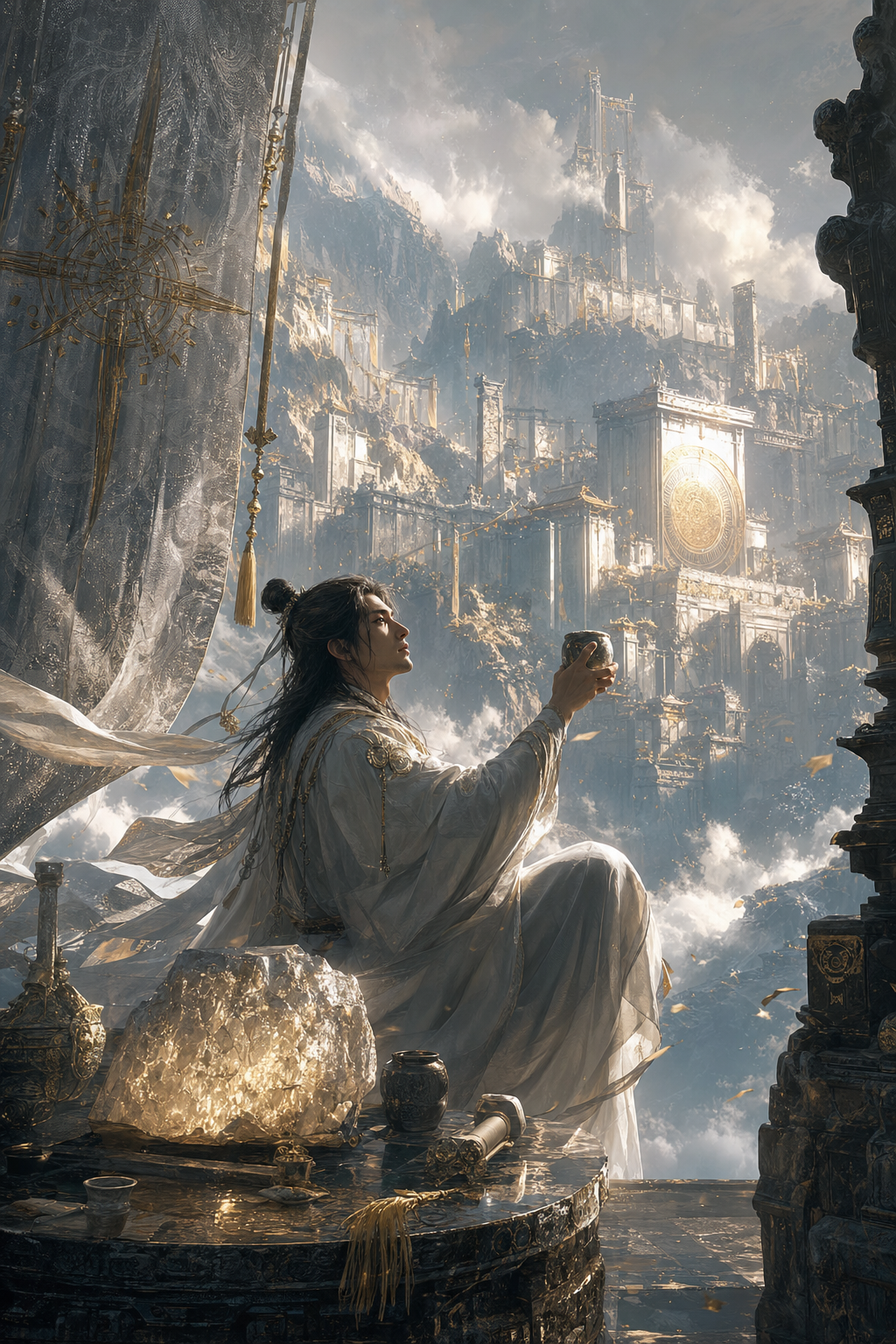
The Brightstone Elegy
An exiled swordsman returns to a radiant mountain empire and finds its beauty is powered by the living dead.
Chapter 1
Kettle's Bend had no use for grace.
The town lay at the foot of the Crowns like a handful of timber dropped beside a river and left where it fell: crooked roofs, mud-packed lanes, smoke that could not decide whether to rise or cling. By dusk the market road was a ribbon of ruts and hoof-water, and the wind coming down from the mountains had already lost whatever clean intention it possessed at altitude. Here it carried horse sweat, lamp grease, boiled onions, wet wool, and the sour edge of men who had been traveling too long with money on them.
Edris sat near the back wall of the tavern and finished a bowl of lentils gone cold.
The room arranged itself around him whether he asked it to or not. The innkeeper watered the wine with his left hand and poured with his right, which meant the stronger bottles stayed beneath the counter for customers he liked. The militia sergeant by the hearth kept his cup in his bad hand and his knife in the good one, suggesting habit acquired after an injury, not laziness. A wool merchant at the center table laughed a fraction too late at his own story and touched the satchel at his feet every third breath; he was lying about what he carried and knew no one believed him. In the corner, a boy pretending to sleep on a bench had one boot unlaced and the other tight: ready to run in only one direction.
Edris noticed all of it with the same involuntary precision with which other men noticed a draft under the door. He acted on none of it.
His spoon touched the bottom of the bowl. Across the room someone dropped a cup. A dog barked outside and was answered by another farther off. Beyond the walls, beyond the muddy lanes and the low river and the last of the fields, the Crowns were standing in the dark, though no one here was looking at them.
A man came in carrying a box wrapped in oilcloth.
He was road-bent, one shoulder lower than the other from recent weight. Trader, not local. His boots were mountain-made, stitched for stone rather than mud. He paused inside the door with the small uncertainty of someone entering a room whose instructions had been memorized rather than understood, then let his gaze travel once around the tavern and stop on Edris.
Nothing in Edris's posture changed. Only his hands, resting beside the bowl, became still.
The trader crossed the room.
“You Edris?” he asked.
“I am.”
The man set the box on the table between the cold bowl and Edris's folded cloak. “Paid to deliver this. No questions asked.”
“By whom?”
The trader gave a tired little smile. “Then I was paid well.”
He pushed the box forward, accepted the two coins Edris set on the table without counting them, and went back into the weather. The door opened, admitted a blade of cold air, and shut.
Edris looked at the oilcloth.
The wrapping knot was simple, efficient, and tied by someone whose fingers had learned exactness through repetition rather than labor. Woven through the cloth, almost invisible in the tavern light, ran a pattern of silver thread: six lines crossing and returning, not ornamental but rhythmic, the old identifying weave of the House of Threaded Sound.
He left the bowl unfinished.
His rented room was above a cooper's shed across the lane, narrow enough that one could stand in the center and touch both walls with outstretched hands. The bed had one sound leg and one repaired with stacked shims. The washbasin was cracked through and sealed with pitch. The single window faced north, toward the mountains, though at night the view was only darkness with a paler darkness behind it.
Edris set the box on the table under the window and lit the lamp.
The cloth came away first. Then the cord binding the lid. Then the lid itself, lifting with the slight resistance of old wood swollen once by damp and dried crooked.
Inside, on a bed of folded wool, lay a piece of veilstone no larger than both his palms cupped together.
Even inert, veilstone altered a room. The lamp flame found the mineral and thinned inside it, drawn inward as if the stone were remembering what light had once been. It was pale, almost colorless, but not dead-white; something warmer moved below the surface, the way warmth remains in rock after sunset if the day has been clear enough. No lowland stone held light like that. No lowland stone held anything.
For seven years he had not touched it.
He stood looking down at the fragment while the room tightened around his silence. Then he set his fingertips against the stone.
Warm.
Warmer than the lamp glass. Warmer than the room. Warmer than mountain stone had any right to be.
The first note was so soft he thought, for one absurd instant, that it had sounded inside his own hand.
Then the second came, and the third, and there could be no mistake. Not resonance caused by accident, not memory given shape by longing. A melody. Broken almost as soon as it began, recovering, attempting the phrase again by another path.
He knew it before the line had finished failing.
Lirien used to begin there when she was thinking. Not performing, not composing for others, but circling the edge of an idea and testing which silence might admit it. Three ascending intervals, the last held just long enough to make completion feel inevitable. Then the turn downward. Then the hidden harmony beneath, delayed half a breath, as if the music had decided to trust itself only after hearing itself spoken aloud.
The stone found the first ascent. Lost the turn. Started again.
Edris took his hand away.
The melody continued.
Not continuously. In fragments. A measure. A break. The opening again, thinner this time, then a stray harmonic shivering through the room like light through winter water. The music did not feel recorded. It felt attempted. As if something inside the stone were reaching for a path it could not hold.
His breath had gone shallow without his permission.
He set both hands on the table, leaned over the fragment, and let the old discipline rise in him before he could stop it: the Unraveling sight, the trained perception that read structure beneath surface, pattern beneath performance. For seven years he had used it only in narrow, practical ways—guard work, roads, men with knives and bad intentions. Never on veilstone. Never on anything that might answer.
The answer came at once.
Not mineral.
Not echo.
Identity.
Fragmented, dispersed, under pressure from every side, struggling to maintain coherence inside a medium not shaped for personhood. He felt not words but the architecture of a self trying not to become weather. A pattern he had known as intimately as his own gait, stretched thin across something vast and cold and barely yielding, still reaching.
His vision blurred for a moment, not with tears but with the strain of seeing too quickly at too close a distance. He stepped back hard enough that the chair behind him struck the wall.
The melody faltered. Found itself. Faltered again.
“No,” he said, and the room made the word sound smaller than it was.
He turned from the table and crossed to the window.
The shutter was already open. Outside, Kettle's Bend lay in dark layers of roofline and smoke. Beyond the town, beyond the river's black thread and the road climbing out of sight, the Crowns stood under a wash of starlight, their ridges just visible where the night thinned against snow. Impossible in the distance. Clean in a way nothing below them ever was.
Seven years ago he had come down through those passes with one pack, one borrowed horse, and the conviction that leaving was the only honest motion left to him. He had not looked back then either. Not at the final gate. Not at the last watchtower. Not at the first place on the road where the plateau vanished behind the mountains and the air thickened into ordinary weather.
Behind him, the stone sang the broken phrase again.
He could hear exactly where it failed.
That was the worst part. Not the sound itself. The structure of the failure. Lirien's mind—if this was hers, and it was, there was no other explanation his body would accept—was still shaped enough to reach for music in the pattern she would have chosen, and damaged enough that the phrase could not bear its own weight. It buckled at the same interval each time, as if some pressure from within the stone struck there and scattered the line before it could close.
He knew what that meant.
Or rather, he knew what he had once discovered under the mountain, and what he had spent seven years refusing to place beside a living name.
Elevation to the Resonance, they called it. The supreme honor. Joining the stone. Immortality made luminous.
In the room behind him, the immortality in the box could not finish a melody.
Edris stood with one hand against the window frame and looked at the mountains until the shape of his choice became visible in the dark not as argument but as absence. There was no life here to preserve. No oath except the one he had made alone, and that oath had always been refusal, never purpose. He owned a sword, two shirts, a cloak, and enough coin to settle the week's rent. Nothing in Kettle's Bend would remember him accurately. By next market day the innkeeper would have replaced him in memory with another quiet man who paid on time and tipped badly.
Behind him, the stone tried once more.
This time the broken line found, by accident or desperation, a single complete measure before dissolving into a scatter of overtones so thin they were almost not sound at all.
He closed his eyes.
When he opened them, the Crowns were still there.
He turned from the window, went back to the table, and lifted the veilstone fragment into both hands.
Its warmth entered him at once, unsettling in its familiarity. He had forgotten nothing. The weight of it. The faint pulse just below the surface. The way the light in the room seemed to gather itself around the stone as if waiting to be told what shape to take.
The melody trembled beneath his fingers.
“All right,” he said, not to the stone, not to the woman inside it, not to the mountains, but to the line that had already been crossed.
The fragment warmed further, as if in answer.
Before dawn, he had packed everything he owned.
The Continuance is a highland civilization of singing stone, transcendent martial arts, and impossible beauty, all built on veilstone that responds to human presence. Seven years after fleeing its hidden horror, exiled prodigy Edris is called back by a fragment of music from Lirien, the woman he left behind, now dissolved within the stone. To reach her, he must cross a dying empire that wants both his silence and his astonishing clarity, while confronting whether refusal alone is enough in a world this compromised and this worth grieving.
- —Edris — A lowland caravan escort in exile and a former prodigy of the House of Undone Knots, Edris sees the hidden structure inside combat, politics, and lies with frightening precision. He fled the Continuance after uncovering the truth behind veilstone, and returns still clinging to the identity of the righteous outsider who walks away rather than serve corruption.
- —Lirien — A musician of the House of Threaded Sound, Lirien was one of the Continuance's greatest living artists and the person whose practice once moved in perfect unspoken accord with Edris's. Chosen for Elevation after getting too close to an alternative to the system, she now endures as a fragmented consciousness inside the foundation of a new concert hall, reaching him through broken music.
- —Torien — Edris's former master and now the senior Holder of the House of Undone Knots, Torien is a brilliant old seer who discovered the truth decades ago and chose to remain. He is not cruel so much as exhausted, a man who justified an unforgivable bargain for the sake of preserving civilization and has been hollowed out by that choice ever since.
- —Auren — The Voice of the Continuance rules with intelligence, restraint, and genuine love for the civilization she is trying to save. She knows exactly what veilstone costs and still defends the Folding as the least terrible option while the golden age decays, making her Edris's most formidable adversary because her argument is not false, only incomplete.
- —Devara — A senior musician in the House of Threaded Sound and the quiet center of the resistance, Devara helped send Lirien's final fragment to Edris. She survives through compromise, secrecy, and patience, offering safe passage and hard truths to those still trying to resist from within.
- —The Recall: In the lowlands, Edris receives a small piece of veilstone carrying Lirien's broken melody and returns across the Crowns to the Continuance he swore never to see again. Re-entering its luminous cities and responsive stone, he is forced to face both the civilization's overwhelming beauty and the hidden suffering beneath it.
- —The Descent: Edris reunites with Torien, learns the Folding has accelerated into a system that cultivates future sacrifices, and reaches Halcyon, where Devara reveals that Lirien has been made the living core of a new concert hall meant to prolong the empire's life. At the foundation he touches the stone and finds Lirien still present, fragmented but unmistakably herself.
- —The Snare: As Edris investigates the hall's architecture, he discovers Lirien is being shaped into an eternal instrument for the entire veilstone network. Auren confronts him with the Continuance's strongest defense, and a Holder's examination reveals that his own clarity could sustain the civilization for generations, making him its most coveted resource and placing his freedom in direct conflict with Lirien's fate.
- —The Inversion: In hiding, Edris resumes the old forms and turns his piercing perception on himself, recognizing that his exile code is both truth and armor. Through renewed contact with Lirien and a desperate collaboration with Torien, he uncovers the beginnings of a different path: veilstone can answer willing resonance rather than forced dissolution, and the original sin of the Continuance may never have been necessary at all.
- —The Clean Note: A descent to the deep quarries reveals natural veilstone already alive without sacrifice, exposing a thousand years of avoidable cruelty. Faced with the choice to flee again or remain and build a harder, honest future, Edris commits himself to the work of remaking the bond between people and stone, setting the empire on a painful transition and finding, at last, a form of beauty that does not hide a scream beneath it.
The prose is formal, lean, and lyrical, moving with the control of a sword form rather than ornamental flourish. Its sensory world is all altitude, cedar, cold light, vibrating stone, and music that can wound as deeply as steel. The mood holds splendor and grief in the same breath, treating martial mastery, longing, and moral horror with utter seriousness.