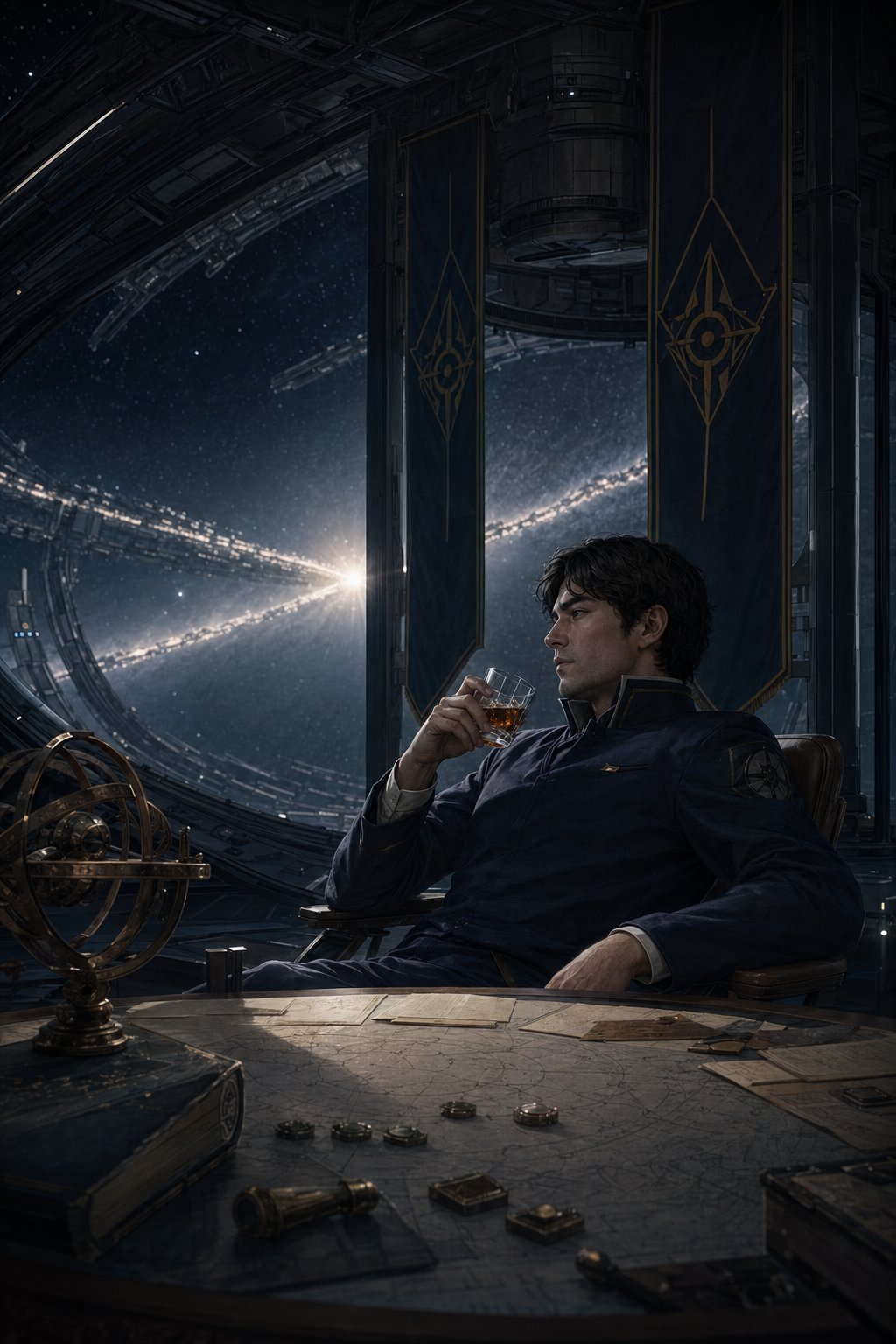
ATTRITION
In a relay network built from human minds, a veteran operator must keep civilization connected as the job erases her.
Chapter 1
The harmonic drift measured 0.003 hertz above last week's baseline.
Hale Soren watched the number settle on the calibration display, waited through one full verification cycle, and touched the secondary readout to confirm the array was not introducing its own error. The number remained where it was. Within tolerance. Nominal variance. Nothing in the station's alert architecture cared enough to color it red.
She adjusted the damping curve anyway.
Themis-9's relay chamber was built around the interface column like a chapel built around a machine part. The column rose three meters through the center of the room, sleeved in field regulators and signal housings, its outer shell matte-black to prevent visual distortion from the lensing discharge. Around it, the chamber's consoles described a ring of human access points: calibration, routing verification, neural interface diagnostics, emergency dampers. The floor carried the station's constant vibration. After sixteen years Hale felt changes in that vibration before the instruments confirmed them, not because the instruments were poor but because her body had learned the station's grammar.
She eased the damping curve by 0.2 percent, watched the relay field settle, and logged the adjustment.
Nominal frequency variance, within operational tolerance. Minor damping compensation applied. No further action required at this time.
The language wrote itself. The Corps had been using the same language for longer than Hale had worn the uniform. It was precise. It was sufficient. It carried what needed carrying and did not carry anything else.
A signal request flashed on the peripheral board. Two packets queued from Themis-8 inbound, one priority governance channel from Vereth, one medical telemetry burst from Caul. Hale put her hand on the interface cradle.
The cradle opened to her palm print and neural profile. Sigma-IV authorization accepted. The station routed the incoming distortion through the neural array, and the Brink came into her head.
No two packets ever arrived warped in the same pattern. The dead stellar remnants that made the corridor possible also twisted every transmission that touched them, folding data into chaos no machine had ever learned to fully unfold. Hale did what the relay existed to have her do: recognized the pattern as if it were half a proof she had once solved, completed it, and sent it on.
Governance packet first. Compressed budget revisions for the corridor's agricultural shipments. Corrected and transmitted in 2.4 seconds.
Medical telemetry second. Fetal cardiac irregularity flagged on a colony clinic three systems inward, requesting specialist review from a core-world hospital. The distortion had bitten deep into the waveform, enough that an automated system would have blurred it into statistical uncertainty. Hale caught the missing intervals, rebuilt them, and moved the packet with full-priority routing.
The routine of it mattered. Civilization, in the end, arrived as sequence. Packet. Correction. Transmission. Next packet. She did not need to think about colonies or councils or the family on the other end of the medical telemetry. The station thought in throughput and fidelity. Hale's work was to make that abstraction true.
By the time the queue cleared, the chamber hatch had opened behind her.
"Calibration gain holding?" Lian Orsic asked.
Hale did not turn immediately. She confirmed the outgoing packet integrity, closed the routing window, and only then looked over her shoulder. "Holding."
Lian stepped down into the chamber with a toolkit in one hand and a diagnostic slate under the other arm. She wore engineering gray instead of operator black, sleeves rolled, dark hair pinned back with the same clip she had been using for years because it had once survived a capacitor burst and therefore had earned permanence. Seven years on Themis-9 had made her movements as economical as anyone in station command.
"I got a jitter on interface feedback from Console Two during your last cycle," Lian said. "Probably a sensor lag. Probably."
"Probably" from Lian meant she had already run three checks and was here for the fourth.
Hale shifted aside to give her access to the console housing. "It's been dragging twelve milliseconds on disengage."
Lian glanced up. "You were going to tell me that after shift?"
"I was going to tell you when you asked why my logs included a manual compensation."
Lian set down the toolkit. "You make my life difficult in extremely predictable ways."
"That should make it easier."
"It does."
That was most of their conversation, most days. Half-completed lines across a shared frame of reference. Lian opened the console panel and began tracing the feedback assembly by hand, not trusting the station's own sensor package until she had felt the housing settle under her fingers. Hale returned to the calibration board. Beside her, metal clicked lightly against metal as Lian worked.
The chamber hatch opened again. Senior Signal Officer Desh Halyard leaned in without crossing the threshold.
"Traffic spike from outer line," he said. "Three Wayfarers stacked at approach and Themis-10 says one of them's carrying live cryonic cargo. Routing wants your correction priority."
"I'm finishing here," Hale said.
Desh gave one look to Lian, one to the calibration board, and nodded. "Two minutes."
He left. The hatch sealed.
Lian tightened something inside the panel. "The Wayfarers always find the exact minute you have the chamber open."
"The corridor does not consult maintenance schedules."
"It should. I'd submit the recommendation if anyone listened to engineers."
"They would route it to administration."
Lian made a quiet sound that might have been a laugh. "Then no."
The console flashed amber as she ran a direct diagnostic. The feedback jitter appeared, stuttered once, vanished. Lian narrowed her eyes, adjusted the contact mesh with a tool so small it looked ornamental, and ran the test again.
"Hold your hand in the cradle," she said.
Hale did. The interface accepted, the mesh synced, and a pulse of low static passed over her wrist bones.
"Disengage."
She withdrew her hand.
The timer on the slate read clean.
Lian shut the panel. "There. Now if it misbehaves again I can blame something more interesting."
Hale looked at the repaired line, then at Lian. "Thank you."
Lian's expression did not change much, but something in it loosened. "Go save commerce."
Hale left the chamber at a controlled pace that became a faster one once the hatch sealed behind her. Themis-9's central corridor curved slightly with the station's ring geometry, all practical lighting and deck plates worn to matte by years of traffic. Crew passed her without slowing: a technician carrying sealant canisters, one of Maret Dien's med assistants with a sleep-cycle cart, Desh already halfway back toward Operations. The station did not have enough people for wasted motion.
Operations sat one deck above the relay chamber, broad enough for six active consoles and one wall display showing corridor traffic, packet queues, and the warped starfield beyond the main viewport. The viewport dominated the room without anyone ever naming it important. Outside, the Brink bent the background stars into arcs and doubled points, a field of white distortions slowly shifting as Themis-9 held its focal orbit. Beautiful because the physics required it.
Desh had already tagged the incoming ships. Three cargo vessels in staggered approach, one priority medical transport riding second in line. Hale moved to the primary correction console while Desh rerouted the queue around her access lane.
"Signal drift on any of them?" she asked.
"Third vessel's nav package is running old compensation tables," Desh said. "Captain says they updated at Themis-11. Themis-11 says they did."
"Then both are true from different angles."
Desh's mouth moved by a fraction. On Themis-9 that counted as shared amusement.
Hale opened the first calibration stream. The ship's approach telemetry arrived chewed by Brink distortion and shipboard shortcuts, but the core pattern remained where it should. She corrected, transmitted, moved to the second. Live cryonic cargo, as promised. The transport's navigation margins had narrowed enough that a poor correction could cost a human body in transit years from now, in a hospital none of them would ever see. Hale rebuilt the packet and returned it clean.
Third ship: older package, sloppier signal, cumulative error smeared through every layer. She stripped the distortion apart, found the underlying route map, and rebuilt the correction tables manually.
Desh watched the traffic board. "Captain's requesting verbal confirmation."
Hale keyed the channel. "Themis-9 to freighter Pelican Ash. Updated calibration uploaded. Your prior compensation package was carrying layered drift from two nodes. New tables are current to station baseline. Advise acceptance."
A burst of static. Then a woman's voice, tired and professional. "Accepted, Themis-9. We were feeling the corridor widen. Appreciate the clean line."
"Maintain approach lane seven until marker update."
"Lane seven. Copy."
Hale closed the channel.
The words stayed nowhere in the room. Feeling the corridor widen was pilot language, not Corps language. It translated poorly into reports and perfectly into experience. She moved to the next packet before the thought could develop.
Shift turnover came and went as it always did: status review, outgoing queue summary, maintenance flags, one note for Maret about Signal Officer Tovin's sleep debt. Hale signed the end-shift board, rejected the commissary suggestion Desh made by lifting one eyebrow toward the corridor, and took the long route toward quarters instead.
The long route passed the observation gallery.
It was not officially called that. On station schematics it was Viewport Access Three, a recessed alcove off the outer ring where structural requirements had permitted a pane large enough for crew orientation and occasional equipment checks. No one with any authority had intended it to become a place people stopped. It had done so anyway.
Hale stood in the alcove with her hands behind her back and watched the lensing arcs.
The Brink's distortions moved too slowly for spectacle. They required patience. Background stars stretched into rings, thinned, doubled back into themselves, then eased apart as the station continued its orbit through the focal geometry. Beyond the arcs, slightly off the plane of the corridor, the binary pair remained where it always was in this segment of orbit: one star bright and steady, the companion dimmer, spectral analysis showing transfer already underway from one to the other. Hale had been tracking the brightness differential for years in a private file no operational system requested.
The stars required nothing from her.
That was the whole of the gift.
She watched until the station clock ticked over to the minute where watching became delay, then turned away and continued to quarters.
Her room was functional even by Corps standards: bunk, fold-down desk, storage wall, terminal, one shelf of printed mathematics texts she had carried through three station refits because electronic annotation annoyed her in ways she had never had time to correct. She changed out of uniform jacket, sat at the desk, and opened the private file before she had consciously decided to.
Brightness differential: 2.13 magnitudes, unchanged from previous observation window. Transfer asymmetry still visible in outer halo. No repeat period identified.
She added the line, saved the file, and then, after a brief pause, pulled a worn notebook from the desk drawer.
The proof waited where she had left it three nights earlier: a classification problem for a family of seven-dimensional manifolds, half a page of neat notation followed by a denser page where the neatness had broken under revision. Once she had held whole transformation sets in her head and moved through them the way she moved through relay distortions—intuitively, without scaffolding. Now there were more intermediary steps. More written bridges. The work still worked. It simply required different architecture.
She read the last line she had written.
Then she read it again, because the first pass did not open cleanly in her mind.
No alarm followed that. No surprise. Only confirmation. She picked up the pencil and began reconstructing the missing connection one deliberate step at a time, writing what she used to hold, adapting method to circumstance the way she adjusted a damping curve to match a relay's drift.
Somewhere below the deck, Themis-9's station vibration carried on through the structural supports. Packet. Correction. Transmission. Packet. The machine was still breathing.
Hale wrote until the notation resolved, stopped when the next transformation would need a fresher mind than the one she currently had, and set the pencil down.
She sat for a moment without moving. The room was quiet except for life support and the faint distant hum of the station. On her terminal, unopened, a quarterly neural assessment waited in her secure medical inbox. She did not need to open it to know the trendline. She would open it later. She would update the projection model on the encrypted partition of her personal drive. She would do the math with the same precision she brought to corridor traffic and maintenance cycles, because imprecision helped nothing.
For now she looked once at the shelf of mathematics texts, once at the closed terminal, and then at nothing in particular.
Below her feet, the station held the line between stars. Above the viewport ring, bent light from the Brink went on making its slow impossible patterns. And in the space between the two, in a room too small for ceremony, Hale Soren closed the notebook, set it square with the edge of the desk, and let the unallocated minute remain unallocated.
Humanity’s interstellar civilization depends on the Brink, a faster-than-light communications corridor whose signals can only be corrected by rare human operators wired directly into relay stations. Chief Warden Hale Soren is the most valuable operator in the Themis Corridor, and she knows the neural interface is steadily consuming the very cognitive gift that makes her indispensable. As corridor failures mount and the staffing math turns impossible to ignore, Hale must hold the line inside a system that survives by never naming its true cost.
- —Hale Soren — Chief Warden of Relay Station Themis-9 and the finest signal operator in the corridor, Hale has spent sixteen years turning chaos into clarity for worlds that depend on her work. A former mathematical prodigy, she privately tracks her own cognitive decline with the same precision she uses to manage the network, while longing for someone to finally name what service is taking from her.
- —Lian Orsic — Themis-9’s signal engineer maintains the hardware that channels distorted signals through human minds, making her the person closest to the boundary between machine and damage. By reading the interface logs, she has deduced the truth from the engineering side and quietly alters Hale’s console to buy her fractions of protection the system never officially grants.
- —Maret Dien — The station physician oversees neural scans, cognitive testing, and the medical protocols that slow attrition without ever admitting what it is. He understands the degradation mechanism better than anyone aboard, and his clinical relationship with Hale is shaped by a mutual refusal to speak the irreversible truth aloud.
- —Director Asa Meru — Former operator and now director of the Themis Corridor, Meru embodies the system’s hard logic from above. She is not cruel or ignorant; she knows exactly what service costs and still asks others to keep paying it because the alternative is civilizational fracture.
- —The Network: At Themis-9, Hale performs the relentless work that keeps sixteen colonies connected, and the station’s routines reveal a civilization whose bandwidth is literally measured in human minds. Small anomalies in relay performance and the familiar signs of interface fog sharpen the fact that the system depends on a cost everyone can calculate and no one will state.
- —The Pressure: Failures and staffing strain spread across the Themis Corridor, forcing Hale, engineer Lian Orsic, and physician Maret Dien to confront worsening data from their different sides of the same machine. As unofficial adjustments, medical reports, and corridor math begin to align, the unspoken secret becomes impossible to treat as background noise.
- —The Exposure: Summoned into higher-level decision making, Hale sees how thoroughly Corps leadership and civilian governance have built policy around expected operator loss while preserving the language that keeps the truth unnamed. Director Asa Meru makes the structural argument in full: the network cannot survive informed refusal, so silence has become part of the infrastructure.
- —The Breaking Point: Themis-9 faces escalating operational crises that turn abstract attrition into immediate choices about traffic, staffing, and who can still carry the load. Hale’s bond with Lian deepens through acts of work rather than confession, and the station’s compressed loyalties strain as the corridor approaches a point where silence itself becomes operationally unstable.
- —The Holding: With the corridor entering its decisive stage, Hale must decide what it means to remain in the chair when duty, identity, and self-erasure have become the same equation. The final movement follows her through open acknowledgment, institutional consequence, and the attempt to preserve connection in a system that can no longer pretend its human cost is temporary.
The prose is controlled, technical, and unsentimental, using the language of systems, medicine, and command to carry emotion by implication rather than declaration. Its sensory signature is deep-space isolation, warped starlight, console glow, and the bodily strain of neural interface work, with rare moments of quiet beauty breaking through the machinery.