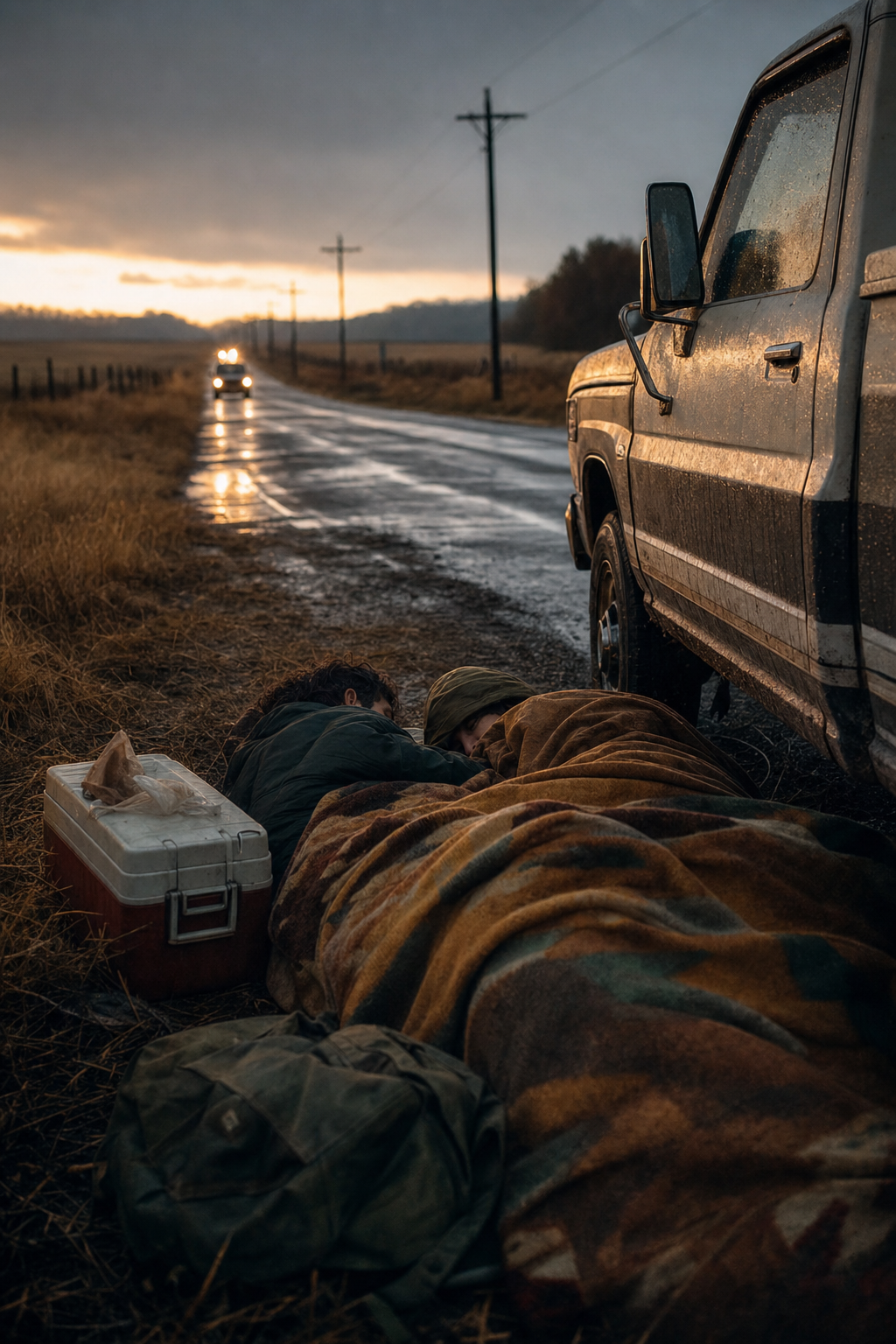
ANYWAY
A runaway and a guilt-haunted captain share an old pickup across the late-November South, where every mile makes leaving harder.
Chapter 1
The tire was flat enough that the rim had already bitten into the gravel.
Nora saw that before she saw the man crouched beside it. A dark green Ford pickup sat crooked at pump two, rear passenger side sagging, the truck bed full of rope, a rusted toolbox, and a blue tarp folded into a square. The man had one knee on the concrete and both hands on a jack that had sunk sideways into the soft edge of the lot. He was talking to it under his breath as if machinery might respond to reason if you kept your voice level.
The gas station itself was one of those places that had survived by becoming three things at once: pumps out front, a convenience store in the middle, and a short-order counter in the back where someone had taped a handwritten sign to the sneeze guard that said BISCUITS TIL 10. Route 70 ran past it in both directions, flat and pale under a sky the color of dishwater. The wind had a wet edge. Rain was coming.
Nora stood just inside the store door with her duffel bag against her leg and read the bus schedule taped crooked to the corkboard beside a rack of local real estate flyers. The next bus south out of Jacksonville was tomorrow at 1:40 PM.
Tomorrow.
She looked at the clock over the coffee station, then at the paper again as if the time might change if she held still long enough. It didn't. She turned away, bought a bottle of water with cash, and stepped back into the cold.
The man at the truck had gotten the spare down and laid it flat in the gravel, but the jack was worse now, listing like a lame animal. He looked up when the door banged shut behind her.
He was bigger than she'd thought from inside. Broad across the back, flannel stretched over his shoulders, faded red ball cap pulled low. His face had the weathered look of somebody who lived outdoors more than inside it. He held the lug wrench in one hand and gave her a quick, easy smile that looked used often enough to fit his face.
“Morning,” he said.
Nora adjusted the strap on her bag and started walking toward the shoulder.
“You don’t happen to know how to talk a jack into respecting its elders, do you?”
She kept walking. Three steps. Four. Then she stopped.
It wasn't kindness. It was the angle of the truck, the way the jack had slid into the mud at the edge of the concrete, the fact that he would be here another twenty minutes at least and she had nowhere to be except outside in weather getting worse. It was a problem she could see with her eyes and solve with her hands. Those had always been easier than other kinds.
She turned, crossed to the side of the building, and found what she'd noticed on the way in: a stack of cinder blocks beside a dumpster, one broken in half. A two-by-four leaned against the wall behind them, gray with age. She took a whole block under one arm and the board in the other hand and carried both back to the truck.
The man stood up straight and stepped out of her way without speaking.
She set the cinder block under the frame rail, slid the board into place, and pressed down until the truck lifted enough to clear the tire by an inch. The wood flexed and held. She nodded once at the spare.
He looked at the setup, then at her.
“Well,” he said. “That’s smarter than what I was doing.”
Nora braced the board with both hands. “Then do it.”
He did. Fast, now that the truck was up. Lug nuts off, flat tire rolled aside, spare on, nuts tightened in a clean practiced rhythm. His hands were good with tools. Not mechanic hands exactly, but hands that had earned their scars honestly. He worked without filling the air for once. Only when he stood and wiped his palms on his jeans did he speak again.
“Thank you.”
She let the board up carefully. The truck settled onto the spare. She picked up the cinder block and board.
“Hold on,” he said. “Least I can do is buy you a coffee.”
“No.”
He smiled again, softer this time. “Lunch, then.”
“No.”
“Ride somewhere?”
That made her look at him.
He tipped his head toward the highway. “You’ve got a bag, no car, and a face that says the bus schedule inside insulted your family. I’m guessing you were hoping for better news.”
Nora shifted the cinder block to her other arm. “I’m fine.”
“Alright.” He stepped back, palms open, no offense taken on the surface. “Worth a shot.”
She carried the block and board back to the wall and put them where she'd found them. When she turned, he was closing the tailgate and checking the spare with his boot.
The sky had gone darker in the last five minutes. The first drops started hitting the pump canopy overhead with a spaced-out ticking sound.
He looked up at the rain, then at Nora standing with her bag by the edge of the lot.
“I’m headed south,” he said. “Jacksonville first. At least get you there dry.”
“No thank you.”
“It’s going to come down in sheets in about three minutes.”
She looked at the road. Flat shoulder. Ditch water already collecting in a thin line of silver. Pine woods on both sides with nowhere to step out of it once it started.
“I don’t snore,” he added.
That was a lie, and he knew it. She could tell by the way one corner of his mouth moved.
She said, “I don’t care.”
“Fair enough.”
The rain came down all at once. Not a beginning, exactly. A decision. The lot blurred white beyond the pumps. Water bounced off the hood of the truck in hard bright drops.
Nora stood under the edge of the awning another second, then another. The man was already moving toward the driver’s side, not looking back at her, not holding the door open, not making the choice theatrical. He got in, started the engine, and let it idle.
She hated that more than if he'd watched.
The passenger door opened on its own with the pull of her hand. She climbed in and shut it harder than necessary. The truck rocked on its springs. Her bag went straight down between them on the bench seat, exactly in the middle, canvas and zipper and stiff handles making a wall where there hadn't been one a second ago.
The man reached up and adjusted the rearview mirror she'd knocked crooked. He didn't comment on it.
Up close the cab smelled like old coffee, vinyl, motor oil, and a trace of something salt-clean that had gotten into the upholstery years ago and never left. The windshield held a crack on the passenger side shaped like branching water. A cassette tape sat half-ejected from the deck. The heater blew cold air that smelled faintly metallic.
He pulled onto the road.
“You want the heat on?” he asked.
“I don’t care.”
He turned it on anyway.
For a while there was only the rain and the truck. Wipers thudding back and forth. Tires hissing over wet pavement. The cab taking on warmth by degrees, slow as a body waking up. Nora kept her eyes on the side window and the wet blur of pines going by. She was aware of him in pieces: one big hand loose at the top of the wheel, the ball cap brim, a flannel cuff darkened with rain.
After ten miles, he said, “I’m Emmett.”
She waited a beat too long, then said, “Nora.”
“Nora,” he repeated, as if testing the shape of it. “That your whole plan? South?”
“Yes.”
He nodded like this was an answer that deserved respect. “Not the worst direction.”
She said nothing.
He tried again five minutes later. “You from around here?”
“No.”
“That sounded like a lie.”
She turned her head and looked at him for the first time since getting in. “You ask everybody this much.”
“Only the ones fixing my truck with building materials.”
He said it lightly, but there was something under the lightness. Not demand. Not nosiness sharpened to a point. Just a man setting words out in front of himself because silence was empty ground and he didn't like walking on it.
Nora looked back out the window. “My father was a mechanic.”
There. Five words, and she wished them back before they were all the way in the cab.
Emmett didn't pounce on them. He just nodded once and kept his eyes on the road.
“That tracks,” he said.
The rain eased as they came into Jacksonville, thinning from a wall to a veil. By the time Emmett turned onto a service road lined with low brick buildings and chain-link fences, the wipers were squeaking on glass that was nearly dry.
The Greyhound station was a squat beige building with a bench out front and a taped notice on the door.
CLOSED FOR RENOVATION. PLEASE USE NEW BERN LOCATION.
Nora read it through the windshield first. Then she opened the door and got out.
The notice fluttered under the tape at one corner. Renovation looked generous. The place looked dead.
Behind her, the truck engine idled.
“New Bern’s forty miles back,” Emmett said from her shoulder, not too close.
“I can read.”
“Figured as much.”
She stood there with her bag in one hand and the station door in front of her and felt the wet cold seeping up through the soles of her boots. The rain had left everything smelling raw. Asphalt. Pine. Exhaust. The day was already giving up its light and it wasn't even five yet.
“There's a motel up the road,” Emmett said after a minute. “Nothing fancy.”
She turned and looked at him.
He lifted one shoulder. “It’s got two beds.”
Nora looked past him toward the road, where the red MOTEL sign was visible through the trees, the M burnt out so it read OTEL in weak neon. She could keep walking. She could stand under the awning of a dead bus station until dark and then what. She could take tomorrow's bus. She could do what she'd been doing since Kinston and keep moving on the strength of spite and bad sleep.
The truck sat behind him, heat still probably trapped in the cab.
She started walking toward the motel. Not because he was right. Because it was there.
He fell into step half a pace behind, carrying his own small overnight bag from somewhere behind the seat. He didn't try to talk to her on the walk. The gravel crunched under both their boots.
The motel office had a bell on the counter and a clerk watching a game show with the sound off. Emmett paid cash for the room before Nora could take out what little money she had. She saw him do it and said nothing because objecting would have required speech and speech would have turned it into a negotiation.
The room was narrow and smelled like bleach and old carpet. Two double beds. A television bolted to a dresser. A bathroom door that didn't close all the way. The bedspreads had a floral pattern faded almost white by years of washing.
Nora put her bag on the bed nearest the window.
Emmett set his on the other one. “Bathroom’s yours first if you want it.”
She shook her head.
“Alright.”
He took the room key, set it on the dresser, and sat on the edge of his bed to pull off his boots. The mattress gave under his weight with a tired squeak. Without the truck around them he seemed larger and less defined, like some part of him belonged to motion and was having trouble settling now that the wheels had stopped.
Nora sat on top of her bedspread in her jacket and watched the parking lot darken through the thin gap in the curtain.
After a while he said, “You hungry?”
“No.”
“That’s convenient, because I’m too tired to go looking for food.”
She didn't answer.
A few minutes later he said, “I do snore, by the way.”
Nora looked at him.
“I lied earlier. Seemed important at the time.”
Against her will, almost without her permission, something shifted at one corner of her mouth. Not a smile. The place one might start if one had forgotten how.
Emmett saw it. He didn't grin like he'd won something. He only nodded once, almost to himself, and lay back on top of the covers with his forearm over his eyes.
When the lights were off and the room had gone blue with the motel sign outside, Nora lay fully dressed on top of the blanket with her back to the other bed and her thumb pressed hard into the center of her opposite palm. She could hear the traffic from the highway, muffled by rain-damp air. She could hear the radiator clicking in the wall. She could hear Emmett breathing, still awake.
Neither of them spoke.
Then, eventually, his breathing changed. Settled. Deepened.
And a little after that, just as she'd been promised, he started to snore.
In the cold backroads of the late-November American South, Nora Colvin leaves a constricting marriage with little more than a bag and her dead mother's boots. When she helps Emmett Kaplan, a stranded fisherman running from a devastating accident, she accepts a ride that turns into days of enforced proximity in his aging truck. As miles, breakdowns, motels, and diner stops accumulate, Nora's hard-won self-sufficiency collides with the unsettling fact that Emmett's presence does not diminish her.
- —Nora Colvin — A 36-year-old woman from Kinston, North Carolina, Nora has just walked out on a marriage that reduced her life to obedience and silence. Practical, mechanically skilled, and fiercely self-contained, she expresses care through quiet acts she would never call tenderness.
- —Emmett Kaplan — A 43-year-old former fishing captain from Morehead City, Emmett is warm, talkative, useful, and impossible to ignore in the cramped space of his old Ford pickup. Beneath his easy humor and constant motion, he is carrying crushing guilt over the accident that maimed his nephew and shattered his life.
- —Glenn Colvin — Nora's husband never appears on the road, but his voice and influence linger through unanswered calls and the habits of control he trained into her. He is not overtly monstrous, which makes the life Nora fled feel all the more ordinary and imprisoning.
- —Marguerite Colvin — Nora's older sister lives in Tucson and represents the first real alternative to endless motion. Her invitation offers safety, family, and a future, but it also forces Nora to confront what the journey with Emmett has become.
- —Caleb Kaplan — Emmett's nephew is the absent center of his guilt, the young deckhand injured by the equipment failure Emmett blames on himself. Though never seen on page, Caleb defines the silence Emmett cannot bear and the self-forgiveness he cannot yet reach.
- —The Pickup: After leaving home on foot, Nora helps Emmett change a tire at a gas station and reluctantly accepts a ride south when buses fail her. In the truck's cramped cab, her silence and his chatter clash immediately, but small gestures of practical care begin to register.
- —Shared Miles: Diners, roadside repairs, rain, and cheap motels turn a temporary lift into an improvised partnership across North and South Carolina and into Georgia. Nora reveals flashes of buried competence, while Emmett's warmth keeps breaking through her defenses in ways that feel both irritating and dangerously welcome.
- —The Seeing: A night encounter with Emmett's private grief and a string of wordless kindnesses shift their bond from uneasy coexistence to mutual attention. When each begins quietly buying, fixing, and remembering things for the other, the truck stops feeling like a stopgap and starts feeling like a life.
- —The Crack: In Alabama and Mississippi, Emmett's unfinished mention of his nephew finally opens into confession, and Nora answers with the truth about the marriage she escaped. After that breach, they move differently around each other: the bag leaves the middle seat, the silences soften, and the question of where either of them is actually going becomes impossible to avoid.
- —The Fork: Real destinations finally appear: a chance for Emmett to work again on the Gulf and a standing invitation from Nora's sister in Tucson. At a Louisiana bus station, they test whether the road has only trapped them together or changed them enough that separation feels more unbearable than the risks of staying close.
The prose is plainspoken, intimate, and unsentimental, with emotion carried through gesture, omission, and concrete physical detail rather than declaration. Its sensory world is all cold vinyl, burnt coffee, wet highways, motel-blue midnight, and Southern roadside light. Humor is dry and human, threaded through a melancholy, warm-hearted realism.