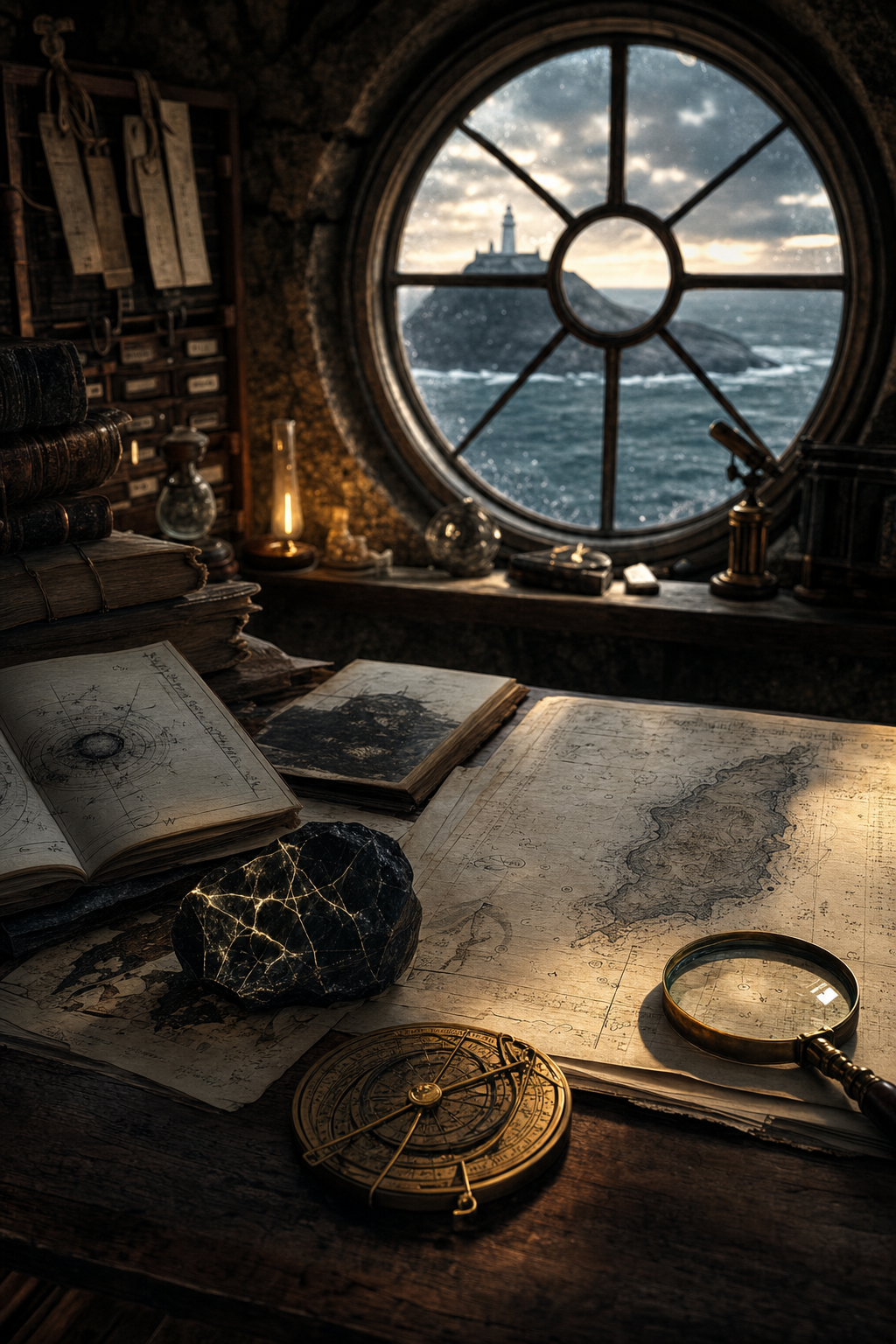
THE ADJACENCIES
On a decommissioned Scottish island, an archivist finds a secret survey proving the world has a hidden depth—and someone wants it sealed.
Chapter 1
The charter boat out of Kinlochbervie made the crossing in forty-two minutes, which the skipper noted was four minutes longer than average and attributed to a contrary tidal set that had been reported, with varying degrees of confidence, in every edition of the Admiralty Pilot since 1907. Maren Trovik, who was the boat’s only passenger, did not record the crossing time. She was looking at the island.
Eilean Cùl emerged in stages from the late-October mist: first the dark interruption in the sea-line, then the western rise of stone, then the lighthouse tower, and finally the house itself, square and grey against the rock as though built from a continuation of it. The island was small enough to be understood at a glance and severe enough to resist the attempt. Maren knew, from the briefing documents and an Ordnance Survey sheet she had studied on the train north, that it measured roughly eight hundred metres at its longest axis. She also knew, from a habit inherited from her mother, that it sat on Lewisian gneiss, among the oldest exposed rock in Europe. The fact seemed relevant in a way she could not yet specify.
“There,” the skipper said, though there was nowhere else she could reasonably have been looking.
The boat pitched once, sharply, as it entered the shelter of the eastern harbour. A stone pier extended from the island with the minimum concession to practical necessity. Beside it stood a man in waterproofs, one hand in his pocket, the other resting on a coil of rope. He did not wave.
Maren had been told that Callum Ennis, keeper of Brathay Station, was sixty-four, lived alone on the island, and would facilitate access to the archive. None of these facts seemed, from a distance, to misdescribe him. He had the compact solidity of someone made durable by weather rather than indifferent to it. When the boat came alongside and he took her case from the deck with an economy of motion that suggested long practice, he said, “Ms. Trovik.”
“Maren is fine.”
He inclined his head in a manner that did not commit him to using it. “Callum Ennis.”
The skipper passed down two cardboard boxes of supplies, then another, then a crate of bottled gas. Callum stacked them on the pier in exact alignment. Maren stepped ashore with more care than dignity. The stone was slick with salt. The boat was already pushing away before she had fully straightened.
For a moment she stood with her overnight bag at her feet and looked inland. The island was as the file photographs had suggested: treeless, wind-scoured, composed almost entirely of stone, coarse grass, and the kind of light that in northern places appears less to fall than to persist. Above the pier the ground rose gently to the station. Beyond the station, on the highest point, stood an instrument platform fenced in galvanized steel. Even at this distance she could identify the standard meteorological apparatus. There were also three shapes she did not recognize.
Callum had lifted her suitcase and two of the supply boxes. “Come on,” he said.
The path to the station had been cut into the rock and repaired, over time, with materials from several centuries. Maren noticed the joins. She noticed the older stonework at the lower edge, weathered smoother than the upper. She noticed, too, the foundation plaque set to the right of the station door. It had been cut deeply enough to survive sea air, and recently enough cleaned that the lettering remained legible.
BRATHAY STATION
EST. 1798
BY THE COMMISSIONERS FOR THE SUPPLEMENTARY HYDROGRAPHIC SURVEY
Maren stopped.
Callum, who had reached the door, turned back. “Problem?”
She was still reading the plaque. “No,” she said. “Only—I’ve never heard of the Supplementary Hydrographic Survey.”
Callum unlocked the door. “Most people haven’t.”
This was not, in itself, surprising. British maritime administration had generated over the centuries a number of committees, offices, boards, commissions, and sub-commissions whose obscurity was proportionate to their confidence. What was surprising was that Maren had spent four years studying eighteenth-century maritime records, had written a dissertation on marginal annotations in charts produced by institutions much smaller and less consequential than anything capable of founding an island station in 1798, and yet had never once encountered the name. Institutions left paper traces. Even vanished ones did so.
She filed the anomaly and followed him inside.
The station’s interior was warmer than she had expected, though not by much. The ground floor consisted of a kitchen at the rear, a small common room with a peat stove, and the survey room, which occupied most of the eastern side of the building and looked over the harbour. Callum showed these to her with a brevity that did not imply discourtesy so much as long-practised sufficiency.
“This is where you’ll be working,” he said, opening the survey room door.
The room was larger than the station’s exterior proportions had prepared her for. A chart table occupied the centre. Along the walls stood filing cabinets, shelves of bound volumes, rolled charts in wooden pigeonholes, and a desk beneath the eastern window. Instruments occupied the remaining surfaces with the mild authority of things still in use: a wall-mounted barometer in a dark wooden case, brass and glass apparatus she did not immediately identify, a radio set, a tide register. The room smelled of paper, salt, machine oil, and old heat.
Maren’s first professional response was numerical. There were more records here than the contract inventory had indicated. Not catastrophically more, but enough to suggest either an incompetent preliminary survey or a definition of “records” that had excluded material she would certainly have included. The second possibility interested her.
Callum set down the boxes and crossed to a tall ledger lying open on the desk. “Station index,” he said. “Everything currently held on site. Main archive downstairs. Restricted material upstairs.”
He did not offer the ledger at once. He let her come to it.
It was handwritten, not printed, on heavy lined paper. The headings were neat, the entries in several hands. The index ran to sixty pages. Maren turned the first few carefully. Logbooks, meteorological returns, chart corrections, maintenance records, correspondence files. The list was comprehensive to a degree institutions no longer paid for. She felt, with some relief, the first sensation she associated with professional happiness: the presence of work that would reward exactness.
“How long since anyone catalogued this properly?” she asked.
“Never, by your office’s standards.” He glanced at the ledger. “By ours, continuously.”
Again the pronoun was interesting. She set the matter aside.
He took her upstairs, showed her the bedroom assigned to her—a narrow room with a sea-facing window, iron bedstead, pine wardrobe, and a wash of cold northern light—and the bathroom next to it. At the end of the corridor stood a door with a lock more substantial than the others.
“That room?” she asked.
“Supplementary Archive.”
The phrase repeated the plaque downstairs. Maren looked at the keyhole, then at him. “Will I need access?”
“That depends what your remit is.”
She had the contract in her bag and knew its wording almost by heart, having read it on the train with the faint suspicion that all temporary employment depended on clauses no one expected the employee to notice. “All documentary holdings of Brathay Station,” she said.
Callum regarded her for a moment. It was not a hostile look. It was the look of someone revising an estimate.
“Settle in first,” he said. “You’ll want daylight.”
By half past three the available daylight had reduced itself to a grey correctness. Maren unpacked with the efficiency of someone accustomed to provisional rooms: books on the sill, notebooks on the desk, clothes in the wardrobe, reading glasses misplaced almost immediately and discovered on top of her head. When she returned downstairs, Callum had lit the stove in the common room and was unpacking provisions with the exactitude of a quartermaster. Each tin and packet went to its assigned place without hesitation.
“You’ve done the ordering yourself?” she asked.
“For years.”
“It shows.”
He looked up, uncertain whether this was criticism.
“It’s a compliment,” Maren said. “Most institutional kitchens have six jars of paprika and no salt.”
A slight movement at one corner of his mouth suggested that, under particular circumstances, he might be capable of humour. “We have salt,” he said.
She took the ledger back to the survey room and began where she always began: not with the documents themselves but with the structure that claimed to contain them. Catalogues, indexes, shelf marks, filing schemes—these were the first maps of any archive, and as with most maps, their omissions were often more informative than their declared contents.
Outside, the lighthouse beam began its work. Every fifteen seconds the window brightened and released itself again.
At six, Callum called her to dinner. The meal was fish stew, bread, and tea, prepared without display and eaten at the kitchen table with the wind beginning to press at the windows. Conversation, at first, confined itself to practical matters: generator schedules, water pressure, the weekly supply boat, the island’s unreliable mobile reception, and the small but absolute rule that if she intended to go out after dark she should tell him first.
“It’s not a difficult island,” he said. “Only small and wet and entirely stone.”
“That’s reassuring.”
“It’s meant to be accurate.”
After dinner she returned briefly to the survey room, unable not to. The recent logbooks had been shelved nearest the desk, presumably because Callum still used them. She drew out the top volume and opened to the current week.
His handwriting was careful and rounded, the hand of a man who wrote daily and expected to be legible to himself in ten years’ time. The entries were routine in a way that ought to have been dull and was not. Wind direction. Air pressure. Sea state. Maintenance notes. Supply delivery. Lamp inspection. Tidal observations at fixed hours. It was, at first glance, the procedural record of a station whose functions had become repetitive long before anyone decided to decommission it.
Then she noticed a recurring notation after the tidal data.
P.I. 0.34
P.I. 0.33
P.I. 0.35
The abbreviation appeared in every entry she checked, always in the same position, always recorded to two decimal places. It was not a standard hydrographic measure she recognized. Maren turned back three years, then five. The notation persisted. The values fluctuated narrowly but not randomly. She felt, in the mild professional way one feels before stronger evidence arrives, the presence of a pattern.
She took the operational manual from the shelf. No mention of P.I.
She checked the front matter of the index ledger. No glossary.
She looked through the survey room window toward the instrument platform, now only intermittently visible when the lighthouse beam crossed it. The unfamiliar apparatus stood black against black.
When Callum came to the doorway, she did not pretend she had been about to stop.
“What does P.I. stand for in the logbooks?”
He answered too quickly for invention and too slowly for ease. “Proximity Index.”
She wrote it down on the pad beside her. “What does it measure?”
His gaze moved, very briefly, to the window and the dark beyond it. “The station’s relationship to certain environmental features.”
This was an answer of recognizably bureaucratic ancestry. Maren, who had read entire filing systems built out of similar evasions, looked back at the open logbook.
“What features?”
A pause. Not long. Long enough.
“You won’t need to catalogue the P.I. readings,” he said. “They’re contextual.”
“Context is archival.”
He considered this. “Not all of it.”
Then, with the practical ruthlessness of someone ending a conversation by redirecting it into necessity, he said, “Weather turns after midnight. If you want air, take it now.”
She did.
Outside, the island was all edge. The air had the clean severity of the far northwest coast in late October: salt, cold, peat smoke faint from the stove vent, and the mineral smell of wetted stone. Maren walked only as far as the rise above the station, enough to see the harbour on one side and the western dark on the other. The island was indeed small. One could feel its perimeter without seeing it. The confinement was physical, measurable, and not unpleasant.
Above her, the lighthouse flashed every fifteen seconds.
Below her, in the survey room, the logbook lay open to a page on which an unexplained index had been entered with the same fidelity as wind speed and tide. On the wall beneath the station roof there remained a plaque naming an institution she had never encountered in any record she had read. On the hill stood three instruments absent from any equipment catalogue she knew. On the upper floor there was a locked room called the Supplementary Archive.
The island was only eight hundred metres long. It already had margins.
Maren stood in the dark until the cold began to work through her coat. Then she went back inside, shut the door against the wind, and wrote, in the first page of her work notebook:
Brathay Station.
Supplementary Hydrographic Survey — unidentified.
P.I. = Proximity Index. Meaning withheld.
Restricted archive upstairs.
Check contract language in morning.
She underlined the second line once, not for emphasis but to indicate incompleteness. Then she closed the notebook, listened to the station settle around her, and understood with professional certainty that the six weeks ahead had just become longer than the schedule allowed.
In present-day northwest Scotland, a remote hydrographic station on a tiny island is being decommissioned after two centuries of service. Maren Trovik, a meticulous archivist hired to catalogue its records, discovers that the station once belonged to a secret survey body that mapped the Adjacencies: a deeper topology of reality hidden beneath ordinary geography. As she uncovers forbidden charts, rising proximity readings, and the work of a vanished predecessor, she is pulled into a struggle between institutional containment and dangerous contact with the world's buried archive.
- —Maren Trovik — A 28-year-old archivist from Edinburgh, Maren is brilliant, exacting, and drawn instinctively to marginalia, anomalies, and buried structures in documents. Hired for routine cataloguing, she becomes the one person capable of reading the station's hidden archive deeply enough to challenge everything its keepers believe.
- —Callum Ennis — Brathay Station's longtime keeper is a weathered, practical man who has spent decades maintaining instruments and obeying containment protocols. Once apprenticed to the vanished Elinor Vass, he knows more than he admits and becomes Maren's reluctant mentor, witness, and moral hinge.
- —Dr. Elinor Vass — A legendary surveyor who disappeared at Brathay in 1978, Elinor survives only through her charts, marginalia, private codex, and a single recording. Her suppressed theory of the Adjacencies reshapes the entire mystery, and her hidden curriculum becomes Maren's real apprenticeship.
- —Aldric Pembrose — A senior civil servant from the Hydrographic Legacy Office, Pembrose oversees the station's shutdown with calm, absolute authority. He is not malicious so much as institutionally certain: the hidden survey must be sealed before curiosity turns catastrophic.
- —Arrival: Maren reaches the storm-beaten island of Eilean Cùl to catalogue Brathay Station before it is mothballed. Routine logbooks, odd instruments, and a mysterious 'Proximity Index' quickly suggest that the station's official purpose is only a cover story.
- —The Hidden Archive: Granted access to a locked upper room, Maren uncovers the records of the Deep Survey Commission, a secret body that documented the Adjacencies beneath ordinary geography. With Callum's reluctant help, she learns the instruments, traces the rising proximity data, and discovers the vanished hand of Dr. Elinor Vass in the margins.
- —Vass's Lesson: A concealed cache and the Vass Codex reveal that Elinor was not merely measuring anomalies but developing a theory of reality as a participatory, mappable depth. Maren reconstructs Elinor's methods, uncovers the island's buried archive-like structure, and realizes the Commission inherited an ancient global tradition it later chose to suppress.
- —Containment: When the proximity index spikes, Pembrose returns to shut the station down at once and remove everyone before deeper contact becomes possible. Under a brutal deadline, Callum finally breaks with the institution, shares Elinor's final evidence, and helps Maren prepare for one last survey.
- —Correspondence: Maren conducts a full-resolution reading of the Adjacencies, using a new approach that seeks contact without surrendering herself to the territory. In the aftermath, the station is sealed, the official archive is taken away, and Maren leaves with copied knowledge that turns the ordinary world into a field of hidden annotations and ongoing survey.
The prose is controlled, precise, and quietly uncanny, treating the impossible with the matter-of-fact restraint of an archival report. Its voice blends institutional exactness, dry intelligence, and old scholarly atmosphere. The sensory world is all Atlantic weather, stone, brass, paper, graphite, humming instruments, and the cold light of a northern island.