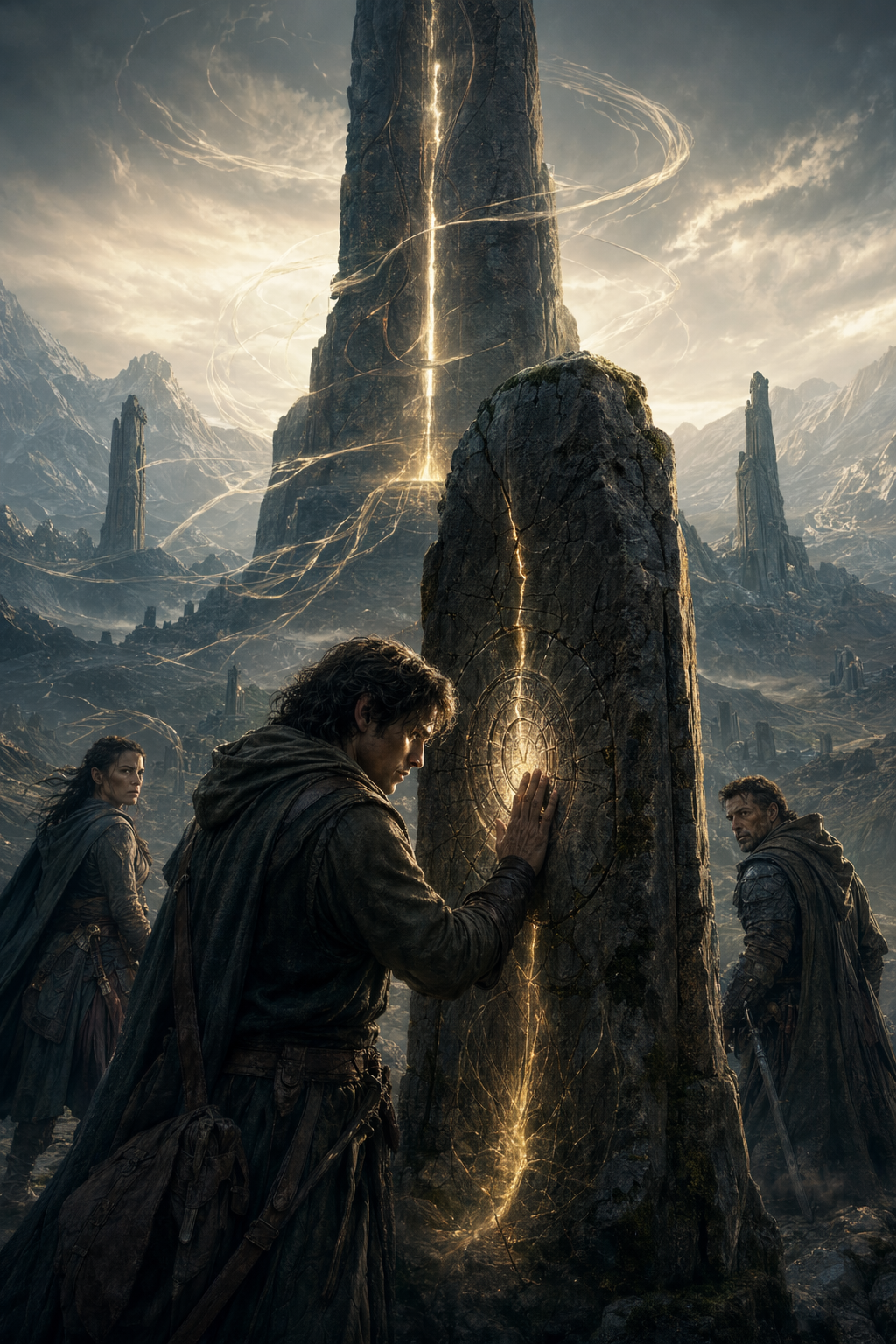
WHAT THE STONE REMEMBERS
In a world held together by ancient stones, a solitary Keeper learns the road he serves is feeding on those who walk it.
Chapter 1
The Setterway ran south through the pine barrens in a line too straight to belong to weather or chance. Its stones were pale grey and broad as tabletops, fitted without mortar so tightly that even autumn's first frosts had found little purchase in their seams. Pine needles had gathered in the joints where the road dipped. Moss took hold where shade held longest. Here and there, a root had begun the patient work of lifting a slab's edge. Edrin marked each such place with the eye of a man who had been taught that roads failed slowly, then all at once, if no one bothered to look before the breaking showed itself plainly.
The day was thin and cold. High cloud had spread across the northern sky until the light turned the color of river-water over stone. The pines stood dark on either side of the road, their trunks straight and tall, the wind moving through their upper branches with a sound like distant surf. Thornfeld lay three days behind him. The Northstave stood a little more than an hour ahead.
He walked with the steady pace of long practice, neither hurrying nor lingering. His pack rode high between his shoulders, heavy with tools: a leather roll of chisels, a mallet wrapped in cloth to keep it from knocking against the stone, mortar compound sealed in waxed skin, a brush for moss, a scraper for lichen. In the side pouch sat the ledger, leather-bound and thickened by years of weather and use. His surveying rod he carried in his right hand. Its ash wood was dark with oil from his palm and scored with old measuring marks cut by his father and his mother and himself in turn.
At midday he stopped where the road crossed a small run of water that fed the Leath farther east. He knelt on the bank, filled his skin, and drank. The water was cold enough to ache in his teeth. He looked south while he drank, at the line the Setterway held through the trees, and saw nothing moving on it. No cart. No rider. No traveler at all.
That did not matter. Roads were not built for traffic alone. A thing could be worth tending even if few feet used it. His mother had said that when he was young enough to resent the work.
Walls crack, she had told him once, handing him a bucket of mortar as if that ended the matter. Roads sink. Stone shifts. You mend them.
He had not argued. There had been no point. She had been right.
He rose, slung the water skin back over his shoulder, and walked on.
By late afternoon the trees thinned around a stony rise, and the Northstave came into view.
It stood on a low knoll where the barrens opened to a ring of scrub and lichen-crusted rock. Sixty feet of pale stone rose from the earth, wider at the base than a cottage wall, tapering only slightly as it climbed. Its carvings covered every side: interlocked lines, branching channels, geometric forms that seemed simple until the eye tried to follow them and found them folding into one another without end. In places the channels held a faint light, not bright enough to cast shadow, only enough to say they were not empty.
Edrin set down his pack and stood for a moment with one hand on the small of his back. The road had been long enough today for his shoulders to know it. The Stave's surface was damp on the north side where shade held, dry and faintly warm on the south where the weak sun had touched it. He circled it once before unpacking, studying the stone as he went.
The western face was sound. A patch of moss had spread into one of the lower channels since last autumn; he crouched and made note of it. The south side showed old frost-scarring near the base, nothing new. On the eastern face he stopped.
A crack ran from shoulder height down toward the second ring of carvings. He had marked it last year. It had been narrow enough then to take only the point of a knife. Now it would take the nail of his thumb.
He set the surveying rod against the stone, crouched, and looked more closely. The crack forked near the bottom, one branch following a channel line, the other cutting across it. Frost had not made that shape. Nor settling. He laid two fingers along the edge of the split and felt the difference in level between one side and the other.
"Wider," he said aloud, because the empty barrens made silence feel heavier than speech.
He drew the ledger from his pack and opened it on a flat stone. The pages smelled faintly of old leather and mineral dust. His grandmother's hand occupied the earliest leaves, narrow and crabbed. His father's entries came later, square and even, each notation clean as a chisel cut. His mother's followed, heavier in stroke, less concerned with beauty than precision. His own hand filled the newest pages.
He found last autumn's entry for the Northstave, measured the crack again with his thumbnail and rod, and wrote beneath it: east face, primary fracture increased by width of nail. Cause undetermined. He added the old Keeper's notation his father had taught him when he was twelve and eager not to get it wrong: two parallel lines, change observed, source unknown.
He looked at the mark for a moment after writing it. Then he closed the ledger and set to work.
Moss came first. He brushed it from the lower channels and scraped lichen from the stone where it had rooted too deeply. He chipped away a little mineral bloom where water had run in spring. He mixed mortar and reset two small edge-stones at the base where winter heave had loosened them. The labor was ordinary and exacting. It occupied the hands well and left the mind to its own road.
Once, while leaning close to clear a clogged channel, he thought of his father's hands doing this same work. Not the man's face. That came less readily now than it once had, and Edrin did not press for it. Only the hands: broad-palmed, calloused at the fingers, always smelling faintly of stone dust and pine resin. Aldric had walked this circuit before him. That was enough. The road remembered even when men did not speak of what it had carried.
By dusk the western sky had opened beneath the cloud, and a pale wash of light lay low between the trunks. Edrin wiped his hands on a cloth and stood before the Stave's southern face. The cleaned channels caught what remained of day and held it.
It was time.
The Kethara had never seemed to him a thing worth drama. It was part of the Round, no more and no less than the ledger or the mortar. He stepped close, set both palms against the stone where the channels widened near the center, and let his breath settle.
The Stave was warm.
The warmth deepened beneath his hands, then became vibration, a low hum too steady to be called sound. It moved through the stone and into his arms with the grave certainty of current through deep water. Edrin kept his hands where they were and opened himself to it as he had been taught, neither resisting nor reaching, only allowing. The Weft passed through his chest like a river finding an old course. There was always a moment in it when his body seemed less solid than the stone, as if his bones had become channels and the Stave the thing more alive than he was.
The hum strengthened. The carved lines beneath his palms brightened. Something in the Stave answered.
Then the current eased.
Edrin drew his hands away and stood still until his breathing settled into its ordinary rhythm again. His fingertips were numb. They always were, after. A deadened tingling sat in the pads of them, strongest in the left hand, least in the thumb. He flexed his fingers once, then twice. Feeling would return in a little while.
He packed his tools in the failing light and made camp beside a low outcrop within sight of the Stave. The fire took after some coaxing. He cooked barley with dried mushrooms and a strip of smoked mutton, ate from the pot, and drank the last of the water he had drawn at noon. The cold sharpened after sunset. Above the barrens the cloud thinned enough for stars to show between ragged gaps.
Across the fire, the Northstave stood black against the sky, its channels holding a dim inner gleam.
Edrin sat with his knees drawn up and the ledger beside him. He could have opened it again. Could have compared this year's crack widths to the last five years' and seen whether the increase formed a pattern. Could have done sums by firelight as his father used to do, speaking the numbers under his breath. He did not. The day had been long, and there was another day to walk before Thornfeld's valley would open below him.
The numbness in his fingertips lingered longer than usual. He pressed his left little finger against his thumb and felt almost nothing.
Cold, he thought, and held his hand closer to the fire.
The pine tops moved overhead. The road lay unseen in the dark beyond the ring of flame, running north toward home and south toward distances he had never yet needed to walk. The Stave stood. The ledger held the measure of its cracks. The fire burned low and steady.
Tomorrow he would go back to Thornfeld, report to Hesta, and put the tools away until the next section of road needed mending or the next season called him out again.
For now there was only the cold stone, the dark trees, and the quiet assurance that the Round, like the road, continued whether or not a man spoke of it.
He fed one more stick to the fire and watched the sparks rise toward the Stave and vanish.
The Hale is an old, wounded world whose coherence depends on towering Staves that channel the Weft, a force that keeps matter, memory, and season intact. Edrin, a young Keeper from the northern village of Thornfeld, tends his isolated circuit as his parents did before him, never fully questioning the numbness and loss the work leaves behind. When Staves begin to fail across the land and the Unraveling spreads north, he joins a hard-won fellowship on the long road to the Heartstave and toward the truth his family kept from him.
- —Edrin — A twenty-eight-year-old Keeper from Thornfeld, Edrin has spent his life walking the northern circuit and mending what the world asks him to mend. He is steady, dutiful, and emotionally hidden, carrying burdens before anyone names them and only gradually realizing what the Weft has been taking from him.
- —Maren — The Keeper of the western circuit is practical, trail-hardened, and fiercely dependable. Her care is expressed through work rather than speech, and her bond with Edrin becomes the fellowship's steadiest source of warmth even as the design keeps demanding separation and sacrifice.
- —Calder — A former garrison soldier turned smith from Stonewall, Calder has already seen the Unraveling erase a village and has lost faith in easy reverence. He joins the journey as a skeptic and witness, challenging the Keepers' devotion even as he is forced to confront what their work prevents.
- —Bryn — A young archivist from Calassene, Bryn is the Hale's sharpest living translator of Setter inscriptions. She brings language to the buried truth of the Staves and serves as the party's fiercest counter-voice, insisting that necessity does not make the system just.
- —Thassen — The elderly Keeper of the eastern circuit has given forty-one years to the Kethara, and his failing body shows exactly what that service costs. Gentle and lucid even in loss, he becomes living proof of the future waiting for Edrin if the road continues unbroken.
- —Aldric — Edrin's absent father haunts the journey through maps, survey marks, and the lie that he merely went south to tend a distant Stave. His true fate, uncovered on the road, reveals both the tenderness and the cruelty buried inside the Keeper tradition.
- —Sera — Edrin's dead mother trained him for the Round while concealing the full price of it. Her silence preserved both her son and the system, making her memory inseparable from the question of whether love can become another form of entrapment.
- —Hesta — The elder of Thornfeld stands at the edge of the story as one of the few villagers who senses there is more to the Keepers' work than duty and weathered hands. She anchors the home Edrin leaves and returns to, and her quiet recognition gives the ending its hardest simplicity.
- —The Round: Edrin tends the northern Staves as part of the life inherited from his parents, noticing widening cracks but treating them as one more burden to carry. When Maren arrives with news that a western Stave has split and the land around it is beginning to grey, he leaves Thornfeld for the first time in years and starts south.
- —The Road South: Joined by Calder in Stonewall and Bryn in Calassene, Edrin crosses a world whose ordinary stability is starting to strain at the edges. Archive texts, damaged Staves, and the old Keeper Thassen reveal that every Kethara drains sensation, memory, and self from the people who maintain the Loom.
- —The Harrowmarch: As the fellowship enters the Unraveling's front line, they pass failed villages, cracked stones, and a landscape losing color and sound. Edrin's own body begins to show the same cost Thassen names, while traces left by Aldric turn the southern road into a reckoning with the lie that shaped his life.
- —The Heartstave: Near the world's southern anchor, Bryn uncovers the full architecture of the Loom and the devastating price required to renew it. The fellowship is forced to decide whether an imperfect system that consumes its keepers is still worth preserving against a formless collapse that would erase everything.
- —The Return: After the Heartstave is renewed, the company breaks apart into new callings: one remains to record the truth, one to testify to it, and one to keep walking. Edrin returns to Thornfeld altered in body and memory, but with the design now fully known to him, and resumes the Round in a world that still holds at great human cost.
The prose is grave, tactile, and old-world in cadence, with the weight of recovered history rather than modern fantasy briskness. Stone, wind, cold light, distance, and bodily sensation dominate the sensory field, so emotion arrives through action, landscape, and what is quietly endured instead of openly declared.