THE TITHE OF SALT
Across twin timelines, a salt-bound ledger governs the land, and breaking old oaths could turn a dying wasteland fatal.
Chapter 1A — The Archive Smells of Brine
The Archive had once been a salt warehouse, and the building had never forgotten it.
Even now, with its bins long gone and its floor cut by rows of shelves instead of carts, the air held the old mineral weight. Brine lived in the stone. It lived in the mortar seams, in the warped planks of the upper gallery, in the leather covers of the ledgers stacked three deep on the western wall. Edrin could smell it before he reached the door. By the time he crossed the threshold, the smell had settled into the back of his throat like memory.
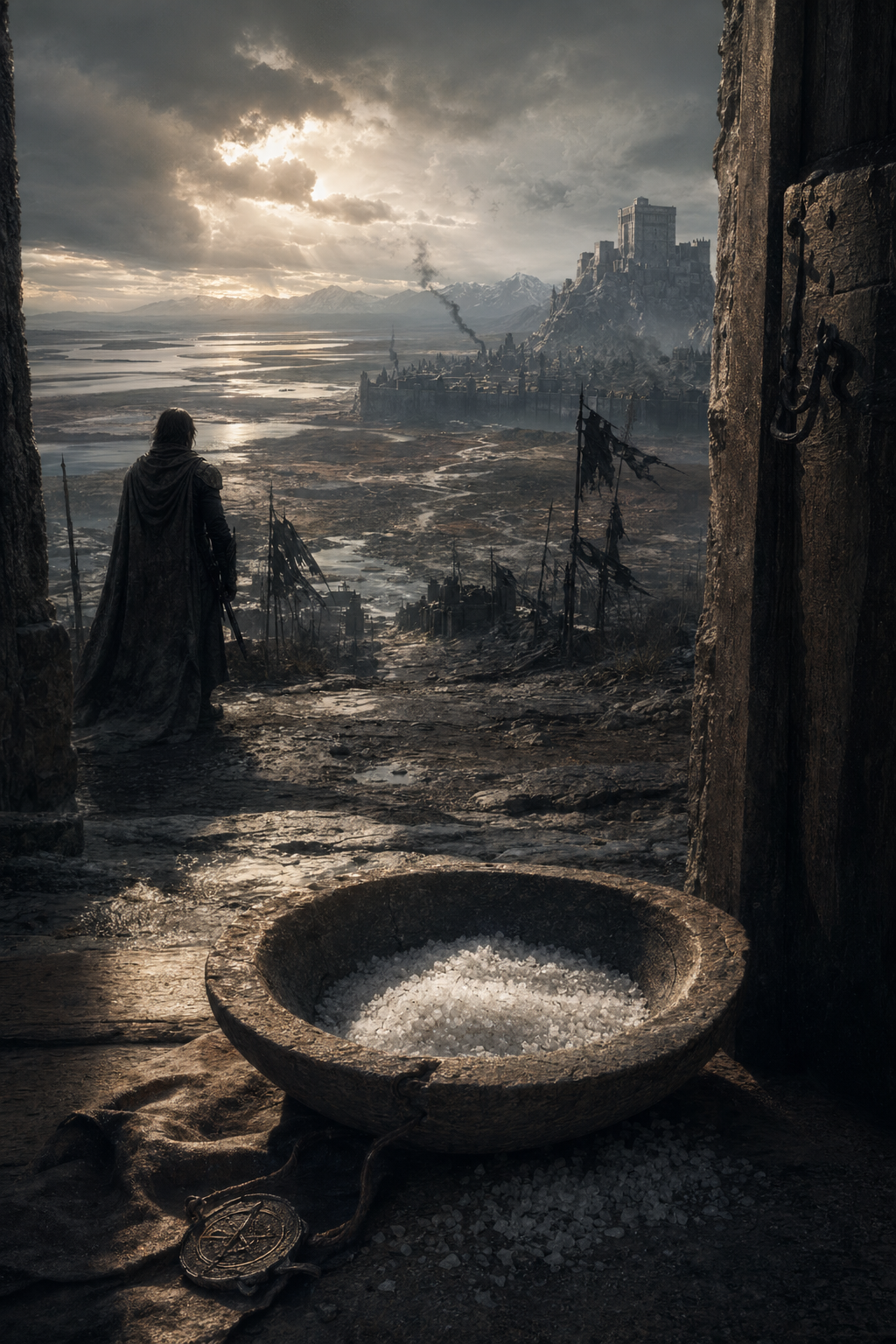
The stone bowl sat to the right of the door, where it always sat. Rough grey rock, broad enough for two hands, heavy enough that no passing shoulder had ever shifted it in all the years he had known it. Fresh salt filled it nearly to the lip. Pellin had replenished it that morning. The crystals were coarse, clean, dry.
Edrin touched two fingers to the bowl as he entered. Salt gritted against his skin. He rubbed his thumb against it once, then went inside.
The journey back from the eastern Hold had taken twelve days. Two weeks gone, if he counted the days spent there walking rotten storehouses, reading supply tallies by lantern light, and persuading a timber factor with three sons and no patience that taking less this season would leave him with more to sell next year. The agreement had held, barely. A bad winter and a worse spring had made everyone meaner than the arithmetic required.
He set his travel satchel on the table beside his desk and stood for a moment without sitting.
The Archive's south wall had cracked again.
He could see the line from where he stood: a narrow split in the limewash running from the second shelf down toward the window frame, finer at the top, wider near the sill where last winter's cold had opened it. The repair from spring had shrunk. Cheap lime. Too much sand in the mix. It would need filling again before frost.
His desk was where he had left it. Ledgers stacked in ordered weights. A shallow tray of reed pens. The seal case. The brass ruler with its edge worn smooth by decades of use. On the left side, under a flat stone to keep the pages from curling, the active lattice register: current obligations, annotated in his own hand where the old terms had begun to fray under new ground.
He sat.
The chair complained under him, one rear leg still shorter than the others despite Pellin's attempt to correct it with folded leather. Edrin rested both forearms on the desk and looked, not at the room, but at the register. His fingers found the edge of the open page before his eyes moved to it. Ink stains darkened the ridges of his knuckles and the side of his hand. They had not washed out in twenty-five years. At this point he no longer noticed them except on winter mornings, when the cold made the skin pull tight and the old stain showed blue.
He opened the satchel. Removed the eastern Hold's copy records, wrapped in waxed cloth. Set them beside the register. Then the timber exchange amendment, sealed by both parties. Then his route notes. The papers made three neat piles. He aligned them by their lower edges.
A floorboard sounded in the outer hall. Lighter than his step. Pellin.
The young man came in carrying a kettle and stopped just inside the room, as if the Archive itself still required permission after three years of work in it. He had dust on his sleeves. His hair had been cut recently and badly, likely by his own hand.
"You're back."
Edrin nodded.
Pellin set the kettle on the warmer. "I filled the threshold bowl. And the west shelf settled another finger's width. I moved the treaty volumes to the lower case."
"Good."
Pellin waited. When Edrin did not ask, he added, "There was a courier from Council."
That made Edrin look up.
Pellin had the folded packet in his hand already. He crossed the room and placed it on the desk without ceremony. The seal was intact: Council mark impressed in wax the color of dry blood.
"Session next week," Pellin said. "I didn't break it."
"No."
"I thought better not."
Edrin touched the wax with one finger. It was still faintly greasy. Not old, then. Sent in haste, or at least recently enough to matter.
He broke the seal.
The notice was brief. Council convening, seven days hence. Agenda appended. Attendance required of all central officers of the Lattice.
Beneath that, on a second page, the appended matter itself.
The Rebalancing Proposal.
He read it once. Then again, more slowly.
The language was careful. It always was when someone intended to gut a structure without appearing to strike it. Current yield inequities. Adaptive allocation. Preservation of productive efficiency in altered geographic conditions. Invocation of the supermajority provision under the emergency yield articles, old enough clauses that no one in Council had likely read them in full until someone profitable put a finger on the correct line.
He set the paper down. Picked it up again.
The three wealthiest Holds had put their names to it. North Basin. Red Mouth. Kerrow Flats. Between them they had the richest new exposures and enough allied votes to make the attempt real.
Technically, the mechanism was valid. That was the filth of it. The Lattice had always contained provisions for rebalancing when the ground changed enough to make the old distribution impossible. Those provisions had been written for flood and storm, for temporary shifts in access, for a season or two of loss. Not for a sea that had spent three generations walking away.
He looked past the paper to the active register.
His hand moved to the ledger where he tracked the connected obligations that no one outside the Archive seemed able to hold in mind at one time: timber against salt, salt against route rights, route rights against winter stores, winter stores against marriage portions, labor shares against spring repairs. Grain of every promise. Weight of every delay. The page before him was thick with notation. He rested two fingers against a column halfway down and held them there.
Rebalancing, if it passed, would not merely reduce allocations. It would strip the poorer Holds of the historical margins that kept them solvent through bad yield years. Those Holds would default first on timber, because timber always came after food. Timber failures would cut refinery maintenance. Reduced refinement would lower usable output even where raw harvest remained possible. Distribution contracts would fail next. The southern routes, already strained, would take the first impact. The chain after that spread wider than a room could hold.
He could see six seasons ahead with one glance. Eight, if nothing unusual intervened. Less, if someone panicked and broke extraction terms to cover a deficit.
Pellin was still standing there.
"What is it?" the young man asked.
Edrin folded the proposal once, precisely on its original crease. "Council business."
Pellin did not move. "Bad?"
Edrin set the folded pages beside the register. "Yes."
That was enough for Pellin to understand there would be no more until Edrin had finished thinking. He turned back to the kettle, poured hot water into the blackened pot they used for salt-tea, and measured leaves without speaking. The small domestic sounds sat quietly in the room: water, ceramic, the light scrape of lid against pot. The Archive had always made room for such sounds. It held them the way it held dust and brine and records no one wanted until they needed proof that they had once promised something better.
Edrin drew the eastern Hold's records toward him and began to work.
He entered the amended timber terms first. Then the revised transport allowances. Then the names of the two guarantors who had agreed, reluctantly, to stand for the difference until thaw. His pen moved without hesitation. Date. Hold. Obligation class. Secondary dependencies. Margin note where the agreement touched a broader chain already under strain.
As he wrote, the Archive settled around him into its known shape.
The floor was worn smooth between his desk and the eastern stacks where the oldest route ledgers lived. The third shelf on the north wall bowed slightly in the middle under the weight of pre-recession survey books. The window latch never fully caught in damp weather. One of the lower cases had a drawer that stuck unless opened with pressure from the left side only. The room's long familiarity did not soothe him exactly. It did something narrower and more useful. It placed the weight where it belonged.
Pellin brought a cup and set it by his right hand.
Edrin did not thank him. Pellin did not wait for it. The tea smelled of bitter leaves and mineral residue. He drank once, set it down, and continued writing.
An hour passed. Then another.
Outside, cart wheels sounded once in the lane and faded. Somewhere in the building, a shelf ticked as the afternoon temperature shifted. The south wall crack remained where it was, narrow and patient.
When the eastern Hold's entries were complete, Edrin reached for the proposal again.
He laid it flat this time. Smoothed the page with his palm. His eyes moved over the names, the vote counts projected in the margin, the legal citations chosen with such care. It was all there. Not sabotage. Not even malice, not in the clean sense. A legal mechanism assembled by men who had decided current yield mattered more than inherited balance and who either did not know or did not care what else the mechanism would sever when it cut.
He turned the proposal over. Blank on the back.
For a moment he looked at the empty paper and saw, as he sometimes did when fatigue had thinned the distance between thought and image, the chains behind the words. Defaults branching. Route failures. Timber rot. Wells salting early. Soil hardening where an oath had been broken and no one had bothered to mark it paid.
He set the page down before the image could become indulgence.
Pellin was at the west shelf now, reshelving a bundle of copied court decisions. "Should I prepare the council records?" he asked.
"Yes."
"Which years?"
Edrin considered. "All prior yield adjustments. Emergency provisions. Default adjudications for thirty years."
Pellin looked over his shoulder. "Thirty?"
"Yes."
Pellin nodded once. That, too, was enough. He began pulling volumes.
The light shifted by degrees toward evening. It came through the south window in a flatter color now, touching the edges of the ledgers and the brass ruler and the crack in the wall without softening any of them. Dust moved in it. Salt did not. Salt only sat and waited.
Edrin closed the active register. Not because the work was done, but because this part of it was.
His hand remained on the cover a moment longer than it needed to.
Pellin, carrying an armful of volumes to the sorting table, glanced at him and then away. The young man had learned enough, in three years, to recognize a pause and leave it untouched.
Edrin took up the Rebalancing Proposal once more and slid it beneath the stone on the corner of his desk, beside the ledger where the cascade was already half-written in numbers no one outside this room would read until the ground translated them into something larger.
Then he reached for a fresh sheet of paper and began making the notes he would need for Council, his script even, spare, exact.
At the door, the threshold bowl remained full.
In a coastal hinterland where salt seals every oath and the land itself punishes broken bargains, a vast network of obligations once held kingdoms, trade, and survival together. Three centuries apart, two quiet keepers stand at the same fault line: Edrin Vael, a Grainsman watching the old order fail from within, and Noor, a causeway keeper asked to guide an expedition into the poisoned ruins left by that collapse. As hunger, politics, and desperation mount, both must decide whether honoring an ancient ledger is worth the cost when the living need relief now.
- —Edrin Vael — A meticulous Grainsman in the age of the Salt Holds, Edrin can trace how a single broken agreement will ripple through an entire civilization. He has spent years quietly preventing collapse, only to realize that his competence may be hiding a disaster no one will stop.
- —Noor — The last Saltwright of Threshold East, Noor maintains the causeways across the Pale and keeps old salt rituals alive without fully understanding their source. When asked to lead a salt extraction expedition, she senses the ground itself is warning against repeating an ancient mistake.
- —Rielle — A hard-traveled route trader, Rielle knows where the Lattice fails in practice and speaks with a bluntness Edrin cannot. She is his closest ally and the one person able to force his private knowledge into the open.
- —Davan Sarthe — Edrin's former mentor was once the greatest Grainsman of his generation before he accepted comfort in exchange for silence. He stands as the unsettling proof of what happens when endurance gives way and integrity becomes too expensive to keep.
- —Callum — A charismatic Threshold merchant-politician, Callum pushes for reopening the ruins because his people are already dying from poisoned water. He is compassionate, pragmatic, and dangerously convincing precisely because his urgency is justified.
- —Osren — An elderly former Saltwright, Osren preserves fragments of oral knowledge that survived the Severance when the written system was lost. He recognizes that Noor's rituals are not superstition but a half-forgotten technology for keeping the land in balance.
- —The Ledger: In the age of the Salt Holds, Edrin sees the ancient Lattice of salt-bound obligations buckling under ecological change and political self-interest. In the ruined present, Noor learns that her community wants to cross the Pale and mine the salt buried beneath the old world.
- —The Crack: Edrin gathers proof that defaults, land failure, and moral debt are linked, but every warning is softened by his own quiet repairs and by leaders who benefit from denial. Noor enters the ruins, recovers an unreadable ledger and an old stone bowl, and begins to suspect the Pale is not dead ground but unsettled ground.
- —The Weight: As the Holds vote for policies that will accelerate collapse, Edrin is pushed toward a choice between silence, exposure, and complicity. In the present, Noor and Osren uncover that the ancient obligations were never settled, and Noor tests a first ritual act that proves the land still answers the old terms.
- —The Severance: Edrin finally releases the truth, only to watch those in power use it to justify more extraction, triggering the chain of defaults and ecological ruin that becomes the Severance. Under pressure from sickness, politics, and time, Noor races across the Pale to settle the deepest debts before her own age repeats the same catastrophe.
- —The Threshold: After the old world breaks, Edrin preserves the record of what happened and helps lay the foundations of the harsher mountain society that follows. In the present, Noor's work transforms the possibility of extraction from a reckless raid into a survivable practice, forcing her community to rebuild its future on patience, memory, and paid-for ground.
The prose is grave, precise, and tactile, with a weathered epic-fantasy register that favors stone, salt, wood, wind, and the feel of burdened ground underfoot. It moves through political tension and ecological dread without melodrama, then opens into rare moments of hard-won warmth. The sensory signature is mineral, austere, and bodily: brine on skin, cracked causeways, brittle timber, cold bowls of salt at the door.