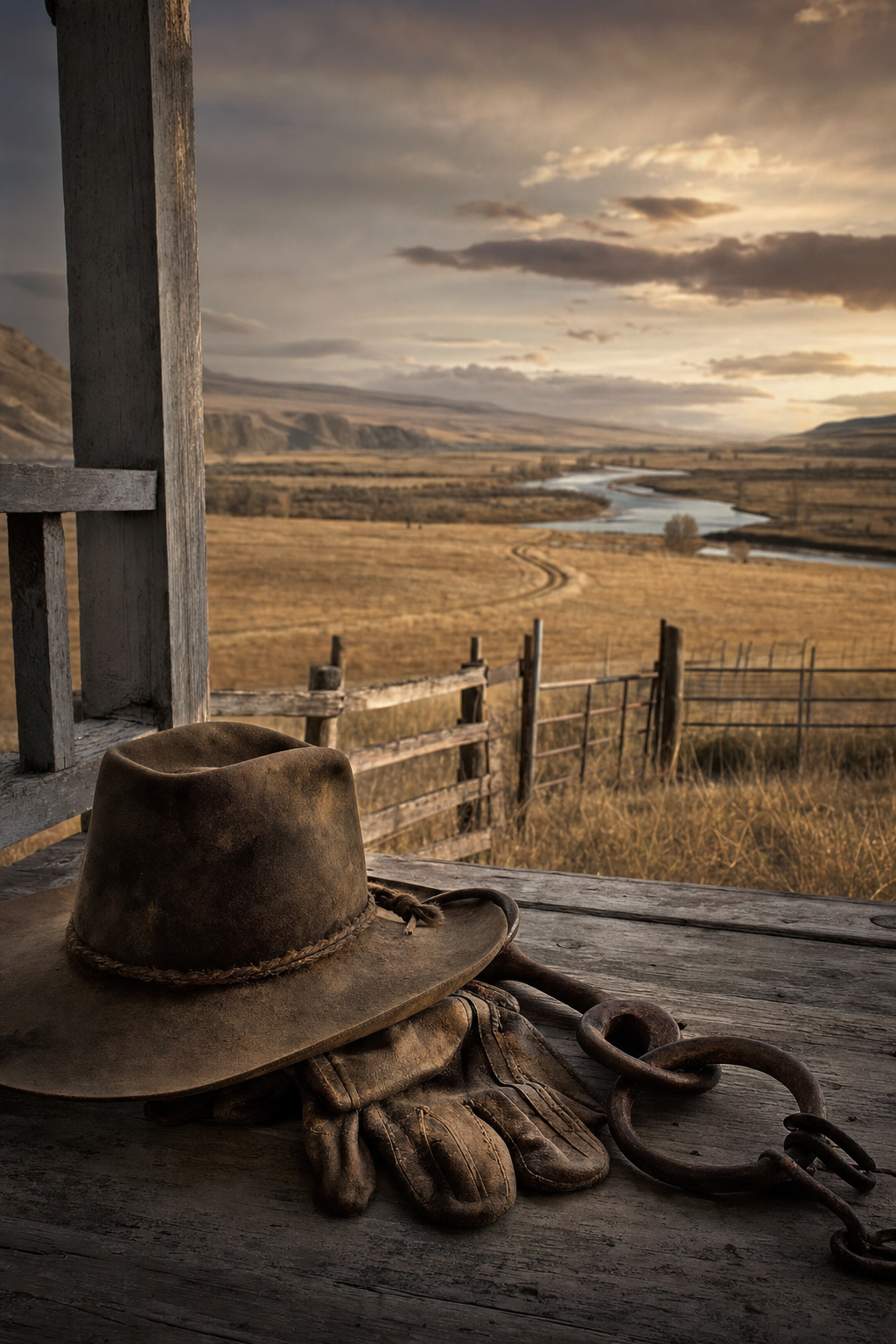
THE LAND REMEMBERS WHAT YOU WERE WILLING TO LOSE
On a failing Montana ranch, a stoic cattleman fights a power-line easement that threatens the riverbank where his family's buried truth lives.
Chapter 1
The cold got to him first through the left hip.
It always did after an hour in the saddle, a slow hardening low in the joint that told him exactly how long he had been riding and exactly what kind of day the body meant to offer him. Samuel Holbrook shifted his weight in the stirrups and let the bay gelding pick its way along the eastern fence line while the dark thinned over the Musselshell valley. To the west, the Spine was still a black cut against a paler sky. To the east, down through the sage and the frost-stiff grass, the river corridor lay as a deeper line of shadow under the cottonwoods.
The wind was up before dawn, not strong, just steady. It worked at the seams of his coat and found the gap between glove and cuff. He rode with his collar up and his hands quiet on the reins. Dozer's breath smoked in front of him. Saddle leather creaked with each step. Somewhere down in the draw a magpie started up and then stopped.
He passed the family plot on the low hill northwest of the house without turning his head much. Four stones behind the black iron fence. Oren. Vera. Earl. Martin. They sat in the half-light the way they always sat, plain and level with the ground, not asking anything from him this morning that they had not asked every morning for years. He registered them and rode on.
The ranch buildings had already dropped behind him. From here they looked temporary, the house and barn and corrals squared off against the slope under too much sky. Eleven miles south the dirt road met the county highway and the world beyond it. Up here there was fence, pasture, ridge, river. The same order as yesterday. The same order if a man did his work.
At the first gate he dismounted, his boots hitting frozen ground hard enough to send a brief clean pain up through the bad hip. He opened the chain, swung the gate through, rode on, got down again to close it. His right index finger, the crooked one, caught on the cold link and slipped. He swore once under his breath and moved on.
The eastern boundary ran straighter than most of the ranch because Earl had built most of it himself in the seventies and Earl had liked straight lines and exact intervals. Samuel could see his father's hand in the spacing of the posts even now. Twelve feet. Plumb. Wire stretched right. Thirty years of weather and elk and cattle pressure and still the line held where a weaker one would've gone soft.
Frost silvered the top strand. The grass below was the color of old brass.
He saw the survey stake before he reached it. Orange flagging tied to a wire rod, the plastic snapping in the wind with a sound too thin to belong out here. It stood twenty feet inside the property line near a shallow dip where runoff cut across in spring. Cleanly driven. Official.
Samuel reined Dozer in and sat a moment, looking at it.
Then he swung down. The ground was hard enough that the soles of his boots rang faintly on the stones under the grass. He took the rod in his gloved hand and pulled. It came free with less resistance than it should have, leaving a neat dark hole in the pale ground. He looked at the hole. Looked at the orange flag. Folded the flag once around the rod and slid the whole thing into his saddlebag.
Dozer shifted and blew through his nose.
Samuel put a hand on the horse's neck, not a pat, just contact. “Easy.”
He mounted and rode on.
The light came slow. It did in October. Nothing dramatic about sunrise in this country most days. The dark just gave ground by inches until the valley showed itself in pieces: the sage first, then the fence line running ahead of him, then the cottonwoods by the river, their leaves mostly gone now and what remained turned flat yellow against the gray. Beyond them the Musselshell moved low in its banks, clear this time of year, showing stone through the shallow runs.
He knew to the foot where his land stopped at the river and where it began again above the bend. Knew the places cattle crossed easiest in August. Knew where the bank undercut after spring runoff. Knew which cottonwood would lose a limb in the first heavy snow because it had been leaning wrong since June and he had not yet had time to take it down. There were a lot of things on this place he had not yet had time to get to.
At the bend he slowed without meaning to.
The river there curved west then south again, the current pressing against a low bank under a stand of older cottonwoods. Their roots showed in places where water had eaten the dirt away over the years. Just above the high-water line, where the grass gave way to bare stones, a low cairn sat under the trees. River rock. Two feet high maybe. Weathered enough to belong if you didn't know better.
Samuel rode past it.
His hands shifted on the reins. Not much. A small correction a horse wouldn't notice and another man might not either. He kept his eyes on the line ahead and felt the cairn beside him the way a man feels a scar under a shirt when weather changes.
The river made its usual sound there, thin over stone. The wind moved through the branches overhead. Nothing else.
He checked the lower stretch, found one staple pulled loose where an elk had jumped the wire, and fixed it there with fencing pliers from the saddlebag. Cold metal in his hand. One staple bent, another set right. He worked without hurry. The sky had gone from gray to a thin white that made every shadow long. By the time he finished, his hands had started speaking in the morning's second language, the one after the hip: stiffness through the knuckles, a reluctance in the left thumb, the right hand stronger than the left but slower to open.
He flexed both hands once, hard, and put the pliers away.
On the ride back he passed the family plot again. This time the light was enough to read the names if he'd wanted to. He didn't. The stones were where they were. Martin's among them. The date line cut into granite as if granite settled anything.
He rode down to the barn, unsaddled Dozer, rubbed the horse out where the cinch had dampened the hair, forked hay into the stall, and stood a minute with one hand on the gelding's shoulder while the horse started eating. The barn smelled of hay, manure, leather, iron. Familiar enough to count as silence.
Lee Carver's truck wasn't by the foreman's cabin yet. He'd be in after daylight.
Samuel crossed the yard toward the house. The boards of the porch gave the same under his boots they had for years. He opened the mudroom door and stepped into the warmer dark of the house, carrying cold air with him.
The kitchen was as he'd left it before dawn. Coffee grounds in the tin by the stove. A cast-iron pan drying on the rack. Earl's hat on the peg by the back door. Light just starting to reach the window over the sink.
There was a letter on the table.
White envelope. Forwarded label from a Billings law office over a state return address. Montana Department of Transportation printed in the corner.
Samuel took off his gloves. The left one caught at the stiff fingers and came free all at once. He laid both gloves on the table, then set his hat down on the letter without opening it.
He went to the stove and poured coffee from the pot he'd left on low heat. It had gone bitter sitting there. He drank it anyway, standing at the sink. Through the window he could see the hill with the graves on it and, farther off, the valley opening east toward the river. The survey stake rode in the saddlebag out in the barn. The hole it had left in the ground was likely already fading in the frost.
He stood there until the coffee was gone.
Then he set the cup down, took the hat and the letter together, and slid both into the kitchen drawer where bills and branding papers and calf-sale receipts already lay in a square, ordered stack.
The drawer shut clean.
Outside, a truck came up the road from the south, engine note familiar even at distance. Lee.
Samuel turned from the drawer, reached for the coffeepot, and poured another cup.
In Montana's Musselshell River valley, Samuel Holbrook keeps his aging family ranch alive through relentless labor, mounting debt, and a code of silence inherited from the dead. When the state and an energy company move to take an easement through his river corridor, they endanger the exact ground tied to his brother Martin's hidden death. As his grown son strains to escape the ranch's suffocating legacy, Samuel is trapped between holding the land, protecting the lie, and keeping the next generation alive.
- —Samuel Holbrook — A 58-year-old Montana rancher whose scarred body and disciplined silence are the living record of three generations on hard ground. He is fighting to keep his family's land while guarding the truth of his brother's death, even as that silence threatens his relationship with his son.
- —Martin "Marty" Holbrook — Samuel's 24-year-old son, capable on the ranch but desperate for air beyond it. He loves his father and the land in pieces, yet feels himself being slowly crushed by a legacy he did not choose and does not fully understand.
- —Lee Carver — The Holbrook ranch hand and Samuel's closest companion, a weathered laborer whose loyalty is built on fifteen years of shared work and unasked questions. He becomes the only person strong enough to witness Samuel's burden without trying to remake him.
- —Earl Holbrook — Samuel's dead father still rules the ranch through habit, memory, and the harsh family code he left behind. He believed endurance, silence, and holding the ground were the same thing, and his legacy is both the ranch's spine and its wound.
- —Martin Holbrook — Samuel's older brother, dead since 1992 and absent in a way that shapes every living relationship on the ranch. Officially he died in a river accident, but the truth of what happened to him is the secret at the center of Samuel's life.
- —Janet Cahill — A competent state land-acquisition specialist assigned to secure the transmission corridor across Holbrook land. She is not malicious, but she embodies the paper-driven future that cannot read what this valley has cost the people who hold it.
- —Helen Holbrook — Samuel's estranged ex-wife, a former schoolteacher who left when his silence became a wall neither marriage nor parenthood could cross. Though she lives offstage, her departure marks the long domestic damage of the secret Samuel carries.
- —The Ground: Samuel's daily routines on the Holbrook ranch establish a life built from labor, debt, and silence in Montana's Musselshell valley. Survey stakes, legal notices, and a private cairn by the river signal that the land is about to be contested and that Samuel is guarding more than acreage.
- —The Siege: As Janet Cahill brings an easement offer tied to a transmission-line project, Samuel refuses terms that would rescue the ranch financially but surrender the river corridor. At the same time, Marty talks of leaving for Wyoming, and Samuel begins to see the same dangerous pressure in his son that once gathered in his brother.
- —The Crack: The legal threat hardens into eminent domain, Lee notices the river cairn, and Samuel's fear for Marty becomes impossible to ignore. Under mounting pressure, he finally admits to Lee that Martin did not die the way everyone believes, opening the first breach in three decades of silence.
- —The Break: After a brutal injury in winter strips away his last defenses, Samuel confesses the full truth: Martin walked into the river, and Samuel buried it to protect his father and the family name. Faced with the damage that code has done, he realizes he cannot keep holding the ground, the lie, and his son all at once.
- —The Mark: Samuel chooses to release what he has guarded for thirty-two years, allowing Marty to leave without carrying the ranch as a sentence. He dismantles the river cairn, yields the easement, and returns to a diminished but still-living ranch where father and son can meet on changed terms.
Lean, intimate, and unsentimental, with a close third-person voice that stays rooted in bodies, labor, weather, and land. The prose is spare but exact, rich in tactile ranch detail: wire, cold water, mud, old timber, stiff hands, and winter light over open country. Its emotional force comes through restraint, pressure, and the physical weight of what goes unspoken.